When tweets go bad: Steve Elkington hammered for stupid Michael Sam post

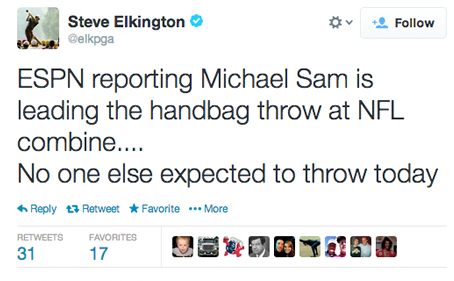
Steve Elkington probably should stay off Twitter for a while.

The veteran golfer is an active tweeter. However, he did one tweet too many when it came to Michael Sam at last week’s NFL Combine.

When Elkington started feeling the intense heat, he followed up by saying he was making a point about ESPN’s excessive coverage of Sam.

Right.

Even if that was Elkington’s intent, it was an incredibly poor way to do it.

Jason Sobel of GolfChannel.com had this to say about Elkington in a column:

I don’t know Steve Elkington personally. His long run of relevance as an elite professional golfer was dying down by the time I started covering the beat in 2004, so other than maybe a couple of long-forgotten news conference questions and recalling that he owned a beautiful swing and an ugly wardrobe, I really don’t know the man.

But therein lies the beauty – and, sometimes, ugliness – of social media.

Through outlets like Twitter, we are able to get to know people whom we otherwise wouldn’t. Unfiltered, unvarnished thoughts straight from the source. When it comes to golfers, many have employed social media as a tool to bring thousands of fans inside the ropes with them. I’ve learned that Ian Poulter has a sports-car fetish, Zach Johnson loves barbeque and Luke Donald has a much better sense of humor than what comes across in interviews.

I’ve also learned that Elkington is hateful, classless and in desperate need of attention.

Bob Harig of ESPN.com reports this isn’t the first time Elkington has come under fire for tweets.

Last year, Elkington came under criticism for Twitter comments made in the aftermath of a helicopter crash into a Glasgow pub.

“Helicopter crashes into Scottish pub. .. locals report no beer was spilt,” Elkington tweeted about the crash.

The accident resulted in several deaths.

Last summer, while playing in the British Senior Open in Southport, England, Elkington tweeted: “Things about Southport … fat tattooed guy, fat tattooed girl, trash, Pakistani robber guy, s**t food.”

He then later tried to explain by tweeting: “Couple caddies got rolled by some Pakkis, bad night for them.”

In the United Kingdom, to refer to someone from Pakistan as a “Pakki” is considered a racial slur. Elkington later apologized and was reprimanded by the European Tour.

Yep, time to take a break from Twitter, Steve.


Why this could affect everyone: Many Dodgers fans left in dark with new network

I did a comprehensive story for USA Today on the loom battle for distribution of SportsNet LA, the new 24/7 Dodgers channel in Los Angeles. The cable and satellite companies are balking at paying the high fee, which will be passed along to consumers.

The impasse has national implications. More so than ever before, the big carriers are pushing back more than ever before when it comes to adding additional sports networks.

From the story.

********

The website has been active for awhile, but the Los Angeles Dodgers and Time Warner Cable are counting on a surge in traffic this week.

SportsNet LA, a glitzy 24/7 Dodgers channel, made its debut Tuesday. However, a large segment of fans in the team’s viewing area weren’t able to view the rollout due to distribution issues with various cable and satellite companies.

Enter IneedmyDodgers.com. The site’s message is intent on rallying the sports TV brigade:

Your voice is important, so make sure you let your provider know you don’t want to miss any Dodgers games and programming on SportsNet LA.”

“We have a passionate fan base,” says Dodgers team president Stan Kasten. “I believe this network is what our fans want.”

But will they be able to get it – and at what price?

Time Warner Cable and the Dodgers are banking on it. The telecommunications behemoth is paying the club $8.35 billion over 25 years to run and distribute the network, which will televise at least 140 games this season.

And so the battle lines are being drawn in yet another showdown between a sports network and the major distributors. DirecTV, Verizon FiOS and AT&T U-Verse are among the carriers balking at charging their subscribers $4.50-$5 month per month to carry SportsNet LA.

ESPN, by comparison, gets about $5.40 per home, TNT $1.20.

YES, the network of the New York Yankees and Brooklyn Nets, charges the highest fee for a regional sports network, at $3.20 per subscriber.

David Rone, TWC Sports president, won’t get into specifics about his network’s fee. As for negotiations over carriage deals for SportsNet LA, he said, “This is par for the course.”

Nothing, though, seems routine in the ever-changing sports TV landscape. Many distributors are saying enough is enough and declining to do deals with sports networks. DirecTV has yet to sign on to carry the Pac-12 Network. Comcast is the only major carrier to air Astros and Rockets games on the troubled Comcast SportsNet Houston.

Sticker shock

Coming up, the new SEC Network is expected to face significant distribution challenges when it debuts later this year, and the Big Ten Network will encounter resistance with its attempt to crack the regional markets of Maryland and Rutgers, which will begin conference play this fall.

Whether you love sports or couldn’t care less, ESPN and other national and local sports networks account for as much as $20 on consumers’ cable and satellite bills.

“Every time you turn around, there seems to be another sports network,” says David Carter, director of the Sports Business Institute at the University of Southern California. “Consumers say, ‘We just spent $5 for this network last year, and now you want another $5 for another network?’ People are starting to feel some sticker shock.”

******

And here’s the link to the rest of the story.


Q/A with Seth Davis on Wooden biography: Coach you don’t know; impact of Sam Gilbert on legacy

There have been several books written by and about John Wooden, and countless stories and documentaries.

Yet you won’t truly know the complete story about the legendary coach until you read Seth Davis’ new book, Wooden: A Coach’s Life.

Davis spent four years researching and writing this comprehensive biography. It gets to the core of a highly complex man.

Despite all of his success, Wooden also was a mass of contradictions. By and large, his players didn’t view him as a beloved coach when they actually played for him. In fact, many despised him. Outwardly, he had a cool, calm demeanor, but in private, he had a quick temper and was prone to epic eruptions.

Then the coach who was viewed as a saint in the business had an infamous UCLA booster, Sam Gilbert, who openly broke NCAA rules by giving players special favors. Wooden never stepped in to stop it. Why and should we think those 10 NCAA titles were somewhat tainted?

It all makes for fascinating reading. Davis’ book is highly recommended. One of the best sports biographies I’ve read in a long time.

Here is my Q/A.

There have been several books written about John Wooden. Why did you decide there needed to be another one?

Davis: Right, but not like this, not what I would call ‑‑ what anyone would call a traditional biography, and certainly he’s somebody who would warrant a traditional biography.

I started thinking about it ‑‑ it really goes back to a column I wrote for SI.com.  It was 2003, and Ben Howland had just gotten hired at UCLA, and I had an idea to get Howland and Wooden together.  I was living in LA at the time kind of in the process of moving back east, and my view was get them together, have breakfast at the same place, and he was a pretty accessible guy, so it was not hard to set up at all.  That breakfast ended up going back to Wooden’s apartment, which I didn’t anticipate, hadn’t even asked for, and sat there for like four hours just talking to him and being around him, and Ben left, and it was just me and him, called my father‑in‑law and surprised him and put Wooden on the phone.

So it was a very cool memory and made for a nice column.  It just would have got me thinking about it and also reading about him, and I almost would have assumed at that point that somebody had written a biography, but nobody had.

You know, it was ‑‑ every book that’s come out, and they’re all wonderful books, but they’re all by Wooden, with Wooden, or for Wooden, so this is the first one in 40 years that’s been written about Wooden.

How do you dive into a book like this?

Davis: You just dive.   It’s like I read a quote once, writing a book is like driving at night, you can only see as far as your headlights, but if you keep driving you’ll get there. You make your list, and you start talking to people.

Who were the difficult guys?  Were you able to get Kareem and Walton?  How difficult was it to get those guys?

Davis:  Kareem’s assistant told me right away, he’s not going to do it, he’s rather do his own book.

Walton was interesting.  Walton absolutely did not want to talk to me, which I knew, but also was too nice to tell me know, so he kept putting me off thinking that I would give up.  He would say, thank you for your patience, and then I thought it would be scheduled and it wasn’t.

I finally stalked him at the Final Four in New Orleans, and I basically said to him, look, if you don’t talk to me here, I’m going to move into your tepee until you do, so let’s get this over with.  We met in the courtyard of his hotel at the Final Four.  It was the Tuesday after the championship game.  It was like a good two years that I chased him, but he wouldn’t tell me no.  Even if he told me no I wouldn’t have accepted it

Did you get Walt Hazzard?

Davis:  You know what, I did.  Actually as this thing was going on I could almost make a list of people who passed away after I interviewed them.  Walt Hazzard had a very bad stroke.  It was really sad, but I did sit in his living room in Los Angeles with his wife.  He was nice as could be, but he just couldn’t talk.  And it was so sad because you ever have one of those dreams where you’re trying to talk and you know what you want to say but you can’t talk?  He knew what he wanted to say, but his brain function to be able to speak was gone, so imagine how frustrating that is.

Who were the guys that really stood out for you?

Davis: Lucius Allen was one of the first people I interviewed, and it was well before I had even gotten a contract.  I don’t know what I was doing in LA, and I don’t know why I picked him to be honest, but I reached out to him and he said, come on over, and I sat on his couch for a couple hours, and this was well before I signed a deal.

Another one of the early guys, just because he lived in Connecticut was Gail Goodrich.  We had a couple of lunches in Connecticut, and he was terrific.  I mentioned in the acknowledgments this guy Kenny Heitz.  You know this as a journalist.  You never know what the interviews are that are going to be real useful.  You just never know, is a guy going to be ‑‑ and I went to Kenny’s loft, sat there for three hours, and he’s a brilliant lawyer and just a really great story teller.  I mean, I left there with so much gold because he’s ‑‑ people really, once Wooden passed, I think people sort of felt like they could talk a little more.

One of the takeaways is that Wooden was a very complex character and he wasn’t exactly what people have their perceptions of them was. I was struck that  the players really didn’t like him that much while they were playing for him.

Davis:  Yeah, it’s interesting.

Well, that’s why I want to write the book, because I knew he was more complicated than he was being portrayed.  In reading these books, he would throw out these little hints, and all these other books would have these like when he’s talking about Bill Sweeney, he just makes an offhanded reference, and ‘then after the game I almost went after him in the shower,’ and then after we played, blah blah blah.  I’m like, wait, what do you mean you almost went after him in the shower?  What the hell does that mean?  There’s a story here.  All those hints.  And when I visited Westwood, I saw the blueprint there.  Hey, this is a competitive guy, and it makes sense.  It was like a light went off.

The guy won 10 championships.  You don’t win 10 championships by reading poetry from your easy chair on your deck.  He got after it.

And then the whole Sam Gilbert thing was just something that fascinated me.  It was just something that everybody in basketball talked about but nobody had ever really explained, and it didn’t make sense.  Well, is he 100 percent committed to these principles of integrity or not?  It’s like being kind of pregnant.

I was very conflicted about the Sam Gilbert thing. He had to have known and he didn’t appear to do anything to stop Gilbert’s activities. What was your take?

Davis: Well, so you can appreciate this.  To me Sam Gilbert was the thing that everybody knows but nobody knows. I would be at these recruiting events and talking to these basketball coaches or other writers, hey, what’s going on, how you doing.  I would say, yeah, I’m writing this book about John Wooden.  If I tell you, every single time, 99 times out of 100, the very first thing out of their mouth was, are you going to write about Sam Gilbert.  Every single time, hushed tone.

Let me ask you something.  Let me guess.  Am I going to write about Sam Gilbert.  Everybody said that.  However, if I would sit down with some friends who were big sports fans, big basketball fans or even certain people in the business who covered, I would explain the whole Sam Gilbert, he was this guy, a booster, they never heard of him.  So it was this gap between something that everybody knew and something that nobody knew.

Yeah, it’s complicated.  Guess what, life is complicated.  Guess what, John Wooden was complicated. first and foremost, I learned how insecure he was.  That to me is ‑‑ I can’t say that it surprised me, but it makes sense.  It made sense.  When I linked his experience of the great depression, losing $909, which was a lot of money in 1932, you get married, you think you’re going to start your new life, you worked all those years of working in the summers and saving away, and you get married and you start your life, and it’s gone.

So that imbued that generation of this very deep belief and understanding that no matter what you’ve accumulated, it could all be gone in an instant, and I think that really informed a lot of what he did, and he was very competitive.

So he was not secure enough to say, him or me.  He was insecure about whatever was going through his mind, he rationalized it, and then after he rationalized it, he ‑‑ I don’t like to say that he was dishonest when he would describe it because I think in his own mind it was true, but what he would say to people, the NCAA looked into it when I was coaching and they found something, just factually inaccurate. So he would explain it in a way that does not jibe with what actually happened.

So these are the layers of a very wonderful and extraordinary man who was not perfect and was presented with a very complicated situation.  The world was bearing down on him from every direction.

If you think about it, if you think about it, and that universe and at that time, Sam Gilbert was a pretty minor ‑‑ I would say secondary pressure point for him.  He had other problems.  He had other problems than Sam Gilbert.  It’s only in retrospect, and where I think Wooden is most vulnerable to criticism on this front is what he did after he was coaching, which is to spend 35 years writing and speaking and lecturing and talking to interviewers like myself about integrity and principles, and here’s how you should live your life and how’s how I lived my life.

So then you have the Bob Knights of the world who have taken a lot of flak for not being as morally upright as John Wooden, and whatever you want to say about Bob Knight, and I’m not a big fan of Bob Knight, but there’s never been a whiff of impropriety with the NCAA with Bob Knight.

As a biographer, you’re less judgmental, you know the mission is to explain what happened. I knew from being on the beat that the Sam Gilbert thing was going to be really interesting to report and to write, to explain and then to watch the reaction of people like yourself.

What kind of reaction have you gotten to the Gilbert part?

Davis:  I think people just really find it interesting.  I don’t think he’s really being castigated.  It’s not like there’s headlines about it.  A lot of people knew about it.  I think a lot of people frankly, when they heard that I would be writing a Wooden book, kind of assumed that I would not address it, that I would skip over this.  I think more than anything people are impressed that I took it on.

I think people are maybe disappointed on a certain level, but if they read the whole book, then I think they know that this book is not a big takedown of John Wooden.  That’s not what I set out to do.  It’s certainly ‑‑ I just think the whole portrait of Wooden in the book I think people see him as real.  Like I think people appreciate the chance to learn more about how he ‑‑ what he was really like and what his life was really like as opposed to the sort of two‑dimensional picture that’s been presented.

We talk about his flaws, but what traits allowed him to succeed, other than having the great fortune of having two of the top three college basketball players of all time almost back to back?

Davis:  No question, although as I say to people when people sort of denigrate, well of course he had ‑‑ Mel Sanders said, yeah, well, that’s five.  Five to go.  You also have one with Dave Meyers and Marcus Johnson.

I think what comes across to me, and I hope to the reader, both how he coached and how he lived, is just his consistency, that he really just kind his hand to the till all those years, and whether he succeeded or failed or lived up to ‑‑ he pretty much stayed the same guy with the same belief system and really kind of stuck to it as best as he could.

And I think that really served him well as those chips were rolling in.  That whole thing about balance, about avoiding peaks and valleys, about controlling the controllables.  I think he pretty much stuck to that.  And if he hadn’t, he would not have been able to manage the ’60s and early ’70s and the tumult and social upheaval and all of that, and I also think even though his players didn’t always understand him and in many ways didn’t particularly like him, I think he genuinely loved them.

I think he had trouble expressing that and showing that to them, but I think in his heart, he really loved them, and I don’t think they would have played hard for him if they didn’t sense that on some level.

They wouldn’t have played for him if they didn’t sense that he really cared for them, and of course that came out over time after he was through playing, when he learned how to express it to them. That’s the other thing that I think you have to give Wooden credit for, that sign on his office wall that said, “It’s what you learn after you know it all that counts,” I think he really lived that.  I think that he really every day tried to keep an open mind because he never believed that he knew it all.

You finished the book writing about your three visits with him. How did those visits shape your image of him?

Davis:  Yes, that’s a great point.  That’s a great point.  I’ve always believed, and I’m sure you’ve had this same experience, that you can only judge people based on your personal interactions.  We’ve all had colleagues where people say this guy is a bad guy, but he’s nice to me.  For me to have those experiences with him and get a sense of what he was like personally, definitely, and they were very positive experiences.  I mean, I really treasured those memories.  Whatever journey I was taking with him, I was going to always end up back in that den with him, and I think that definitely informed the arc of the book.

 

Real Sports: Despite Lokomotiv tragedy, Russian hockey teams still using second-rate planes

Saturday afternoon, NBC showed a terrific documentary, Lokomotiv, on a Russia town’s efforts to rebuild after a plane crash that killed players and coaches in 2011.

Tuesday, the latest edition of HBO’s Real Sports (10 p.m. ET) has a follow-up from Bernard Goldberg that suggests the tragedy could happen again.

Here’s a clip:

The write-up from HBO:

Hockey’s Darkest Day. On Sept. 7, 2011, Russia’s Lokomotiv, one of the premier hockey teams in the Kontinental Hockey League (KHL), boarded a Soviet-era Yak-42 jet at a Yaroslavl airport to travel to a game in Minsk, the capital of Belarus. A few moments after lift-off, the chartered aircraft crashed about 500 yards from the runway, instantly killing 43 of the 45 passengers, including several NHL and Olympic Games veterans. The model of the aircraft carrying the team had a long history of problems and the charter company has one of the worst air safety records in the world. Now, two years after the worst aviation disaster in professional sports history, REAL SPORTS/Sports Illustrated revisits the families and officials who were interviewed in HBO’s original segment in 2012 and correspondent Bernard Goldberg learns more about the latest developments in the KHL’s aviation safety protocol. New interviews include Bethann Salei, whose husband Ruslan Salei, a former NHL player, was killed in the 2011 crash and KHL vice president Ilya Kochevrin.

Posted in HBO

Bart Scott bucks trend; New NFL Today analyst not Hall of Famer, Super Bowl winner

As expected, CBS added Bart Scott to its NFL Today panel this morning.

On the surface, it is a sound move. Scott shined as an analyst on That Other Pregame Show on CBS Sports Network. He seemed destined to get the promotion.

Yet is Scott a big enough name to lure viewers over to NFL Today? While he was a solid player for Baltimore and the New York Jets, he only played in one Pro Bowl during his 11-year career. He never played in a Super Bowl.

Consider the panel on Fox NFL Sunday: Terry Bradshaw, Howie Long, Michael Strahan and Jimmy Johnson. Three Hall of Famers and a two-time Super Bowl winning coach.

NBC, ESPN, and NFL Network also have a wealth of Hall of Famers and Super Bowl winners on their panels.

Now Scott’s new teammate, Boomer Esiason, isn’t in the Hall of Fame and never won a Super Bowl, but he did play in the big game. He also was a MVP and a high-profile quarterback. Scott’s other new teammate, Tony Gonzalez, is a lock to be a first-ballot Hall of Famer.

Scott, meanwhile, was a linebacker and outside of New York wasn’t a big name. In Chicago, where I live, Scott isn’t going to have instant name recognition.

CBS is banking on Scott’s broadcast skills to lure viewers to NFL Today. It is a novel concept. Let’s see if it works.

Here is the official release from CBS:

******

Bart Scott has been named studio analyst for the CBS Television Network’s NFL pre-game show, THE NFL TODAY, elevating his role from last season where he was a studio analyst on CBS Sports Network’s weekly Sunday pre-game show THAT OTHER PREGAME SHOW (TOPS).  The announcement was made today by Sean McManus, Chairman, CBS Sports.

Scott will join James Brown, Bill Cowher, Boomer Esiason and recently named Tony Gonzalez on THE NFL TODAY.

In addition to THE NFL TODAY, Scott will expand his role at CBS providing analysis across multiple platforms, contributing to INSIDE THE NFL on SHOWTIME and appearing in weekly segments on TOPS.

“Bart joining THE NFL TODAY is a natural progression from his outstanding work during his first season on TOPS,” said McManus.  “Bart brings a dynamic personality and unique perspective as a recently retired player providing strong opinions on all the hot-button issues on a weekly basis.  We are confident he will continue to bring that perspective and those opinions to THE NFL TODAY.”

Scott joined CBS Sports in August 2013 serving as a studio analyst during the 2013 NFL season for CBS Sports Network’s Sunday football studio program, THAT OTHER PREGAME SHOW.  Before joining CBS Sports, Scott’s NFL career spanned 11 years playing with the Baltimore Ravens (2002-08) and New York Jets (2009-12).  In 2006, he was a Pro Bowl selection and earned All Pro honors.


Posted in NFL

Olczyk: How about hockey in Summer Olympics? Might be a better scenario for NHL

It seems ridiculous for the NHL to even have a second-thought about whether it will participate in the 2018 Winter Olympics in South Korea.

The ratings were huge again in Sochi. Even more importantly, so was the buzz about hockey.

People interrupted their work during the day to watch the big games. Hockey led sports reports. It was No. 1 on the sports agenda for the past week.

When does that happen in February? Heck, it doesn’t even occur in June during the Stanley Cup Final.

The Olympics are an unparalleled promotion opportunity to expand hockey beyond the die-hards in the U.S. and beyond. It is worth the high price of shutting down the NHL once every four years.

NBC obviously wants to see NHL players in South Korea in 2018. However, it isn’t that easy.

During a conference call last week, Eddie Olczyk actually made a compelling argument that hockey might be a better fit for the Summer Olympics.

Olczyk: “I think when you look at the possibilities or the scenarios, you have to look at the business of the game. This is what it comes down to right, it comes down to the business. You shut down your business, being the National Hockey League, for three weeks, or three and a half weeks if you have to travel another five or six hours to get to South Korea. When you have the best sporting event every four years, I was lucky enough to play as an amateur, back in 1984, thirty years ago for Team USA over in the Olympics in Sarajevo, when you have the opportunity to have the best athletes at these games it takes it to another level it takes our sport to another level. Maybe we’re getting to the point where you might have to get creative where everyone is happy, ownership is happy in the National Hockey League, the Players Association is happy, most importantly the Olympians and the fans of the sport.”

“Maybe we are getting to the point where the game of Hockey has to be played in August in the Summer Olympics. Maybe we are getting to that stage where you don’t have to shut down the National Hockey League for three weeks and slow down your business. Canadian markets, Chicago, Detroit, New York, you can go on and on and on. Those aren’t going to take a hit so to speak, when your business or your team goes away for three weeks. But you have a lot of franchises that are treading water, are having momentum and then all of the sudden you go away for a while. But the selling of the game on NBC, having the best athletes play is something I don’t think you can put a price tag on. Maybe, to make everybody happy, maybe somebody needs to say, you know what maybe we can do this, maybe we can have the game of hockey played in the Summer Olympics.”

******

Meanwhile, Olczyk’s fellow analysts, Jeremy Roenick and Pierre McGuire, made their cases for the NHL to continue to participate in the Winter Games.

Roenick: “In talking to a lot of the players, this event in the Olympics is very important to them. And it’s a very exciting time for them for their families and to represent their country and you talk about the length of travel that they’ve gone through to come here, to stop a season in mid-season as they’re in a race for the playoffs, it’s very difficult, and to have to think about doing that and going all the way to South Korea…it’s going to be really interesting to see what happens after this Sochi Olympics and the travel…how guys are going to feel when they get back. I know the European players, the Russians, the Fins, the Swedes…they’re so loyal and proud of their countries, they’re brought up to want to be Olympians…I know that they would want to be in South Korea, regardless of the travel. I think it’s going to be a very interesting decision.”

McGuire: “I’ll tell you one thing, the T.J. Oshie moment is all you need to know about what the NHL players being at the Olympics is all about. That is one of the most magical moments you’ll ever see. What T.J. Oshie was able to do put the game of hockey right at the front of the entire Olympic spectrum. Without National Hockey League players at the Olympics I don’t know if you can have those moments, I really don’t. So it speaks to the overall appeal of the best players in the world being part of the Olympics. I have not talked to one player that says they do not want to be a part of the Olympics. I have not talked to one. Of all the players I have talked to in the National Hockey League over the last fifteen years, I have not talked to one that doesn’t want to be an Olympian.”

******

Bottom line: I’m betting NHL is on in 2018.

Update: strong ratings for NBC: Despite dire predictions, Olympics always comes through

Update: The final numbers are in, and NBC has reason to be pleased. The network averaged 21.6 million viewers per night for its primetime coverage, up six percent from the last European Olympics in Torino in 2006. The complete release is below.

********

I refrained from using these Al Michaels quotes during an interview I did with him prior to the Olympics. I didn’t want to put a hex on the Games.

But Michaels, a Olympics veteran for ABC and NBC, downplayed all the forecasts of doom and gloom in Sochi.

“Everyone is always worried,” Michaels said. “Will the weather be good? Will everything get done in time? What about terrorism? People even were asking me, ‘Are they going to put you in a Gulag?

“Every Olympics I’ve done, people say, ‘It’s going to be horrible.’ You know what? It’s always works out pretty well. There’s something about the world coming together and you see the best of the best.”

Michaels was right. Despite all the attempt by the Russians to screw things up, the Games won again. And for 2 1/2 weeks, the Five Rings captivated America, just like they always do.

Where else but the Olympics does the country stop on a Thursday afternoon for women’s hockey? And then for the following afternoon for men’s hockey?

I was in a Mediterranean restaurant on Friday night, and I heard the owner, a native of the Mideast, telling a table the back story about a European skiier. Again, where else but the Olympics?

As NBC’s ratings show, where else does a nation tune in night after and night, not to mention take in live streaming on their computer or mobile device, but during the Olympics?

Yes, the Olympics have many flaws, and NBC’s coverage could go over the top at times. But nevertheless we lock in that ski jumper or speedskater or figure skater, athletes we didn’t care about before and won’t after, because we know that this is their once-every-four-year moment to achieve a measure of immorality in their sports. For many athletes, it will be a once-in-a-lifetime moment.

The highs and lows are so powerful and dramatic, and so unique to the Olympics. We may not have a clue of what we’re watching sometimes, but we all know what it means to win a gold medal. We can see it their faces.

Dan Levy in Bleacher Report, who had been highly skeptical prior to the Games, wrote a piece suggesting the Olympics should be held every year.

I would rather write about freestyle skiing than the hand sizes of NFL prospects, and I love the NFL. Sometimes it’s good to give other sports our attention. Some of these sports are really great, too.

Besides, there is human interest at the Olympics. There is a spirit that always manages to transcend athletic competition that we don’t usually get in domestic fixtures.

And part of the fun of the Olympics is finding those untold stories of great athletes from every corner of the globe doing incredible things to achieve their dreams. There are people who spend their entire lives trying to win a medal in a niche sport with very little funding because they flat-out love to compete. Why shouldn’t we celebrate that more than we do?

Why can’t we highlight something that amazing every year?

Levy gives the pros and cons of his idea. Regardless, the logistics of staging the Games would make it impossible to accelerate the time frame.

I’m fine with the Olympics remaining on a four-year cycle. You do need that gap to make the quest for gold feel more momentous.

Thankfully, with the Winter and Summer Games now staggered, we won’t have to wait another four years for Olympics. The 2016 Summer Games in Rio are just 2 1/2 years away.

And it won’t be long before we hear about how construction in Rio is woefully behind, etc…

Let the countdown begin.

*******

From NBC:

NBC concluded its coverage of the XXII Olympic Winter Games from Sochi, Russia with its two primetime telecasts – the Closing Ceremony and the special Nancy & Tonya documentary – ranking #1 and #2 on broadcast television in household rating and average viewership, according to live plus same day fast national data released today by The Nielsen Company.

The Closing Ceremony (8:33-10:36 p.m. ET) averaged 15.1 million viewers and an 8.7 household rating/13 share – both #1 in broadcast primetime.  The Sochi Games Closing Ceremony also topped by 2% the viewership for the 2006 Torino Games (14.8 million).

The Nancy & Tonya documentary (7-8:33 p.m. ET), in which Mary Carillo looked back at the events surrounding the ladies’ figure skating competition at the 1994 Olympic Winter Games and featured an exclusive sit-down with Nancy Kerrigan and a one-on-one interview with Tonya Harding, ranked second in broadcast primetime with 12.7 million viewers and a 7.8 household rating/12 share.

The Closing Ceremony for the 2006 Torino Winter Games averaged 14.8 million viewers with an 8.9 household rating/13 share. The 2010 Vancouver Winter Olympics Closing Ceremony – which followed that afternoon’s dramatic overtime Team USA-Canada men’s gold medal hockey game – averaged 21.4 million viewers with a 12.1 household rating/19 share.

For the Sochi Winter Olympics from the Opening Ceremony on Feb. 7 through the Closing Ceremony, NBC averaged 21.4 million viewers for its primetime Sochi Olympics coverage – up 6% from the 20.2 million average for the last European Winter Games in Torino in 2006.  NBC’s 12.3 household rating/20 share for primetime also topped the Torino Games (12.2 household rating/19 share).  NBC’s primetime coverage of the live (ET/CT) 2010 Vancouver Games averaged 24.4 million viewers with a 13.8 household rating/23 share.

**NOTE** – Complete Olympic ratings, viewership and digital metrics will be released Tuesday.

TOP 10 METERED MARKETS FOR SUNDAY’S CLOSING CEREMONY ON NBC

Market HH rating/share
1. Minneapolis 15.6/24
2. Ft. Myers 13.5/19
3. Salt Lake City 13.3/24
4. Milwaukee 13.1/20
5. Buffalo 12.3/18
T6. Denver 12.2/20
T6. Providence 12.2/17
8. Chicago 12.0/18
9. West Palm Beach 11.8/18
10. Austin 11.4/18


Programming alert: In Play with Jimmy Roberts’ now 1-hour; Construction slowly begins on Olympic course in Rio

Good news for fans for the excellent  In Play with Jimmy Roberts. The Golf Channel has decided make it a one-hour show.

One of the pieces on tonight’s show (10 p.m. ET) looks at designer Gil Hanse and his work on the new Olympics course in Rio.

Here’s the rundown on tonight’s show:

*******

The game of golf is bigger than what we see each week from the professional tours. Every day, people are doing extraordinary things. In Play with Jimmy Roberts returns tonight at 10PM ET where Roberts will explore the very best stories from every corner of the game.

Tonight Jimmy Roberts will take you on a journey that no one has been on before, a behind the scenes look at the making of the golf course where the golfers will play in the 2016 Rio Olympics. You will get an all-access pass to the blueprints, the groundbreaking ceremony and a golf course in the making.

Plus, six-time NASCAR Sprint Cup Series Champion Jimmie Johnson is most well-known for his accomplishments on the racetrack, but it turns out Johnson has quite the connection to golf. Find out tonight how the game of golf has helped Jimmie become a better driver.


William Nack reflects on career: Yes, I did cheer in the press box–for Secretariat

William Nack is the subject of Chapter 2 of the Still No Cheering in the Press Box series by the Shirley Povich Center for Sports Journalism at Maryland.

Alex Silverman and Drew Rauso did a long interview with Nack, a terrific writer who reflected back on his career at Newsday and Sports Illustrated. Proud to say that Nack is a fellow Daily Illini alum at the University of Illinois. He is working on a book another DI alum, his good friend Roger Ebert.

The interview is well worth your time. However, what struck me was this terrific passage at the end when Nack talks about cheering in the press box.

Frankly, I have to confess that in 1973, when Secretariat started pulling away from the field in the Belmont around the far turn, I cheered in the press box. It would be impossible not to cheer in the press box. There are some instances where the feat is so grand, the spectacle so memorable, that it is impossible not to root for an outcome. Granted, I was going to write a book about this horse, I had something going more than just a newspaper story the next day. I had invested days and days of time into this horse, and so I was rooting.

I say to the ghost of Jerome Holtzman, I’m sorry. There is still rooting in the press box occasionally. As a matter of fact, Dave Kindred, a former columnist for the Washington Post, was standing next to Joe Falls, a columnist out of Detroit, and as Secretariat was racing down the stretch, because people had been talking how great a horse Citation was, Red Smith always said you’ll never see another Citation. He was like a god to some people. As Secretariat was pulling away and the clock was going crazy, and he’d already broken the Derby record, and the Preakness record was about to break the Belmont record, it was obvious, Joe Falls said, “Citation my ass!” What a great line in the press box! That wasn’t exactly cheering, but it was a form of acknowledging a feat of strength, which is what cheering is really.


NBC documentary: Kerrigan opens up about attack; Carillo says hard to believe Harding didn’t know

In January, ESPN did a 30 for 30, The Price of Gold, on the infamous Tonya-Nancy affair from 1994. However, there was one thing missing. No Nancy Kerrigan interview.

Kerrigan, who is working for NBC during the Olympics, naturally gave Mary Carillo and  the network a sitdown for its documentary. The one-hour film airs Sunday at 7 p.m. ET just prior to the closing ceremonies.

Kerrigan did meet with the media following a screening of the film Friday in Sochi. Richard Deitsch of SI.com reports:

Kerrigan said that Carillo and Grossi had attempted to get a sit-down interview with her for years and she finally agreed last year. The NBC staffers started working on the project last summer and the pair did two long sit-downs with Kerrigan.

“I trusted them enough to portray my family and the history of this because it is very complicated and long,” Kerrigan said. “It’s 20 years later. I’ve moved on. I don’t revisit this on a daily basis. It was hard at first to sit down and talk for five hours straight and to think about all this. It’s a little surreal to watch your life and to think, ‘That’s me. It’s almost like a whole other person at this point. I have moved on. Things in my life are different. But it is emotional to watch your own life in front of you.”

And there was this from Carillo:

Carillo said she believed Kerrigan had been turned into something she wasn’t by the media, especially the tabloid press. “Someone slugs her on the knee and six weeks later she comes that close to a gold medal,” Carillo said. “All these years later I thought that got lost in the sauce.

Carillo also mentioned she was surprised that Harding remains so defiant. “She claims she was not complicit in it,” Carillo said. “Did I believe her? For me personally after reading everything … it strains credulity for me that she claimed that she didn’t know. But she is defiant. She is standing by her story.”

Posted in NBC