Van Gundy defends harsh comments against Orlando; discusses sensitive players

It should be interesting when Jeff Van Gundy calls an Orlando Magic game next year.

During a teleconference Tuesday, I asked Van Gundy about his comments in a radio interview last week with Stephen A. Smith in New York. He blasted Orlando for not only firing his brother, Stan, as coach, but also for the way they handled it.

I asked Van Gundy if that fact that Stan is his brother impacted his comments. He said:

Sure it had an impact. He’s my brother. I know in the three years before Stan came to Orlando, Dwight Howard had never had a winning record.  And he had never won a playoff game, and he had never been the defensive player of the year, he had never been an all‑NBA player.  So I know all those things.

And so when he was fired, listen, teams have the right to change coaches.  Dr. Jack (Ramsey, also on call) has been through it.  Every coach has been through it except for the very few lucky ones.

But there’s a manner in which you go about changing that shows you have a dignity and an integrity about you.  And so a couple ‑‑ their callous disregard for what Stan helped them do, winning more playoff series in his five years than they have had in the entire time that they’ve been a franchise, add into that he’s my brother, sure, it impacted my comments.

But I didn’t overreact.  In fact, if anything, I underreacted.  Because when you see leadership by appeasement or appeasement as a leadership strategy, I think it’s wrong.  I think it’s wrong for the individual player.  I think it’s wrong for the team and the franchise and that’s what I said in many different ways.

Van Gundy also discussed being ranked No. 2 in a Sports Illustrated poll of NBA players regarding their favorite announcer. Charles Barkley was first.

Van Gundy got the nod despite knowing he’s ticked off a few players with his pointed comments. He said:

I never really knew how sensitive the players are (in making the adjustment from coaching to analyst). You might say 99 percent good things, and if you say one thing that you would like to see have been done differently, they get quite angry. I was doing a game in the Playoffs where a player made a basket and he jogged down court, he didn’t look directly at me, but I knew he was looking towards me, and screamed something out I couldn’t share with you for print.


But I was amazed, I was like, wow, you know, I’ve been ‑‑ like I say what I see, but some of it I didn’t like in a particular game and I said that.  And I didn’t realize how sensitive guys were.


Just in: Did Dolphins sign on for Hard Knocks to help sell tickets?

Looks like the Miami Dolphins are going to use HBO to help sell some tickets.

HBO just announced that the Miami Dolphins will be the subject of this year’s Hard Knocks. Many other teams turned down the opportunity to have their training camp overrun with cameras.

So why did the Dolphins say yes? Here’s a possible reason.

Last year, they ranked 28th in attendance in the NFL, averaging 60,886 fans per game. The Dolphins played to 81 percent capacity at whatever name they are calling their stadium these days; only Cincinnati, at 75 percent, had a lower percentage.

With expectations low for 2012, the Dolphins could use some help selling tickets. Nothing like a five-week national showcase to aid the cause.

So, surprise, surprise new coach Joe Philbin is thrilled to have HBO record his first NFL training camp as head coach.

In a release, Philbin said:

We are excited that the premier company in sports filmmaking history, NFL FILMS, and HBO Sports have chosen the Miami Dolphins to appear on their award-winning series Hard Knocks,” said Joe Philbin, head coach of the Miami Dolphins.   “We are looking forward to connecting with our many fans across the country as the program chronicles our 2012 training camp.  The series will highlight the outstanding men who comprise our team and represent our organization admirably, both on and off the field, as they compete for a coveted position on our roster.

The Miami Dolphins have long been synonymous with success on the fieled as evidenced by our five Super Bowl appearances and the only perfect season in NFL history,” added Philbin.  “That heritage serves as a constant reminder to our players and staff of the great legacy that has been left for us to uphold.  Our team embraces that rich past and looks confidently to the future as we begin this journey back to the top of the NFL.

All the decisions that have been made this off-season have had one guiding principle — will it help our players and organization reach its full potential?  This one is no different.  We are convinced that our affiliation with NFL FILMS and HBO will allow football fans everywhere an opportunity to comprehend the significant sacrifices and demands that our players endure each day along their journey in training camp as a Miami Dolphin.  We eagerly await the opening of training camp on July 26 and the 2012 NFL regular season that lies ahead of us.”

Jeff Van Gundy on broadcasting with brother: He’d verbally assault me

How about this NBA broadcast team? Jeff and Stan Van Gundy working together as analysts.

You’ve got to think it will be discussed if Stan doesn’t land another coaching job. All you have to do is watch the HBO Real Sports profile of the brothers to see what great chemistry they have. Stan has shown he’s just as outspoken as Jeff.

I mentioned the possibility to Jeff Van Gundy during an ESPN conference call Tuesday morning.

“It would be fun,” Van Gundy said. “I don’t get to see that much of him. He’s always busy with his job and we live in two different cities. He’d probably verbally assault me like he has his whole life.”

Van Gundy thinks Stan would be a terrific broadcaster if he decided to go that route. However, he cautioned that his brother should take things slow before deciding his next move.

“Stan is extremely smart, intelligent and insightful,” Van Gundy said. “He does everything with a high amount of candor. With the record he’s amassed, he’ll have multiple opportunities. Unlike a lot of us, he’s smart enough where he can do something outside of basketball. He’s one of those guys who can do a lot of things and do them well.”

I’ll have more from Van Gundy later today.


USA Today is going to make some beat reporters very rich; publisher letter to staff

Clearly, this isn’t going to be your father’s USA Today.

USA Today publisher Larry Kramer has sent out a note to staffers in the wake of several veterans being let go last week in the sports department. The memo appeared in the Gannett Blog, an independent blog not connected with the main company, via Romenesko.

Clearly, Kramer wants USA Today sports to be a player among the major sports sites. Breaking news is the mantra. He writes:

As we recast ourselves into a multi-platform sports organization, it is clear that we must be more aggressive and proactive about how we cover breaking news. While the newspaper remains an important source of news for our sports consumers, we can no longer operate with a print-first mentality. Stories move 24-7 and we need to move at that same rapid pace. The USA TODAY Sports Media Group intends to be the conversation starter, breaking news in Sports faster and in greater depth than anyone else.

Since breaking news is such a priority, it will be interesting to see what high-profile sports beat reporters USA Today adds to its roster. I’m figuring on at least a couple of additions at premium prices.

Here’s the entire note from Kramer:

USA TODAY has earned a reputation as a trusted source for the news and information that matters most to consumers, as well as for its legacy of innovation. One of the things I am most excited about is what the USA TODAY Sports Media Group is doing to help us aggressively reinvigorate that legacy. This team is bringing a whole new approach to the way we cover sports, and today I want to address the realignment of the USA TODAY Sports Editorial group which has been completed this week.

Over the last two weeks, I have spent time with Tom Beusse and his leadership team, getting further up to speed on what they have been working on over the last several months to transform USA TODAY Sports and to, once again, become a true sports powerhouse. As we recast ourselves into a multi-platform sports organization, it is clear that we must be more aggressive and proactive about how we cover breaking news. While the newspaper remains an important source of news for our sports consumers, we can no longer operate with a print-first mentality. Stories move 24-7 and we need to move at that same rapid pace. The USA TODAY Sports Media Group intends to be the conversation starter, breaking news in Sports faster and in greater depth than anyone else.

To get there, the USA TODAY Sports Editorial team has been restructured to emphasize specialization around several different areas of expertise. Work shifts, publishing cycles and priorities are all changing to ensure we are relevant across all platforms.

A careful and exhaustive process was followed, working extensively with Human Resources. More than 90 new job descriptions within Sports were created to meet the needs of a digital organization. Dozens of new positions were made available to staff. This involved an extensive interview process. We were 100% committed to putting the right people in the right jobs. In the end, 16 of the top 21 positions were filled by internal candidates. Also through this process, we were able to uncover previously untapped or underutilized skill sets that further enabled us to create new opportunities for many people within the group.

This process was about redefining and re-imagining our considerable Sports franchise and the roles our people assume within it to create a center of excellence and build a great sports franchise. With this new structure, we are now well-positioned to operate in a 24-7 digital environment. This is a major step forward. We are proud of what we have accomplished to date — in fact, our sports content has already improved significantly over the last 5-6 weeks alone – and, we are excited for what is yet to come. A much more urgent approach to news gathering will sharpen all sports products and allow USA TODAY Sports to compete on a much larger and more meaningful scale. I firmly believe no one is better positioned to play to win in this space than we are and we have the talent necessary to do it.

Larry

Sherman Interview: Great Frank Deford tackles new subject: himself

If somebody asks what’s the best part of doing this site thus far, I say that’s easy: Interviewing Frank Deford.

If there was a Mt. Rushmore for great sportswriters of the last 50 years, one of those faces would belong to Deford. While it would embarrass him to hear it (or maybe not), he remains a hero to people like us who grew up turning to the back of Sports Illustrated to see if Deford had a piece in that week’s issue.

I’m not going to wax poetic about Deford’s work in SI, NPR, HBO and elsewhere, because it wouldn’t do him justice. I know he would write it so much better.

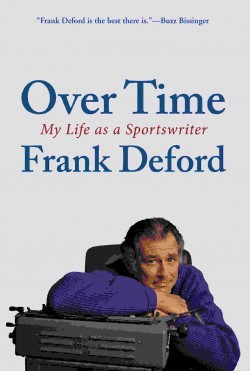
Fortunately for us, Deford decided to wrap up his glorious career in a new book: Overtime: My Life as a Sportswriter.

It’s a terrific read. Deford chronicles his early days at Sports Illustrated in the 60s, when the magazine really hit its stride and changed the face of sports journalism, thanks in part to writers like himself. He writes about covering the biggest of the big; Wilt Chamberlain, Bobby Orr, Arthur Ashe, along with his fondness for obscure tales, such as spending time on the road with a roller derby team. He also weaves in a fascinating treatise on the evolution and current state of sportswriting.

Deford writes that legendary Sports Illustrated editor Andre Laguerre once gave him a piece of sage advice. He said: “Frankie, it doesn’t matter what you write about. All that matters is how well you write.”

Nobody did it better then, and at age 73, Deford shows he still has his fastball, along with several other pitches. He elegantly sums up our craft as only he could.

I asked the bartender if there is any drink named ‘Sports Journalist’? No, he says. So I have made it up: Cheap scotch and Gatorade. Slivorice for hard-nose-ness, sherry for sentimentality, and a dash of steak sauce.

I recently did a Q/A with Deford. It was one of the best hours I have enjoyed in a long time.

Did you ever think you’d write your memoirs?

People would say to me in the last 10 years or so, ‘Hey you ought to write a book.’ I’d say, ‘Nobody wants to read about a stupid sportswriter.’

My wife, Carol, we’re having a drink, and I said, ‘Can you believe it? They want me to (write a book).’ She said, ‘All the stories you tell all the time that I had to hear…Yeah, you’ve got book in you. People are interested in the people you’ve talk to.’ It’s not the Frank Deford story. It’s Wilt Chamberlain relating to me. Or Bobby Orr when he finds out that Larry Bird worships him.

What was it like writing about yourself?

The hard part was writing about me. I think I have a pretty good idea when I write a story through the years of what the reader is going to like. When it’s you, and you’re thinking, ‘That was interesting to me, but will it be interesting to everyone else’?

For a memoir to be any good, people have to relate to you the writer. I had this idyllic life (as a writer). I didn’t have to pull myself up from the bootstrap. I just sort of drifted along.

You didn’t have a conventional career as a sportswriter. You weren’t a press box kind of guy.

I wanted to write about the people more than the games. What I got to do was what I wanted to do. Not many people get to do that. I feel blessed in that regard. And I got to do it at a time when SI was the crème de la crème.

Obviously, dealing with athletes in the 1960s is much different than today. You often were inside their circle. What was that like?

You’ve got to understand that’s the way it was when I got into it. I just assumed that’s the way it was going to be. You’d hang out these guys. They’d bum drinks off you, cigarettes off you. I chased girls with them. I was their age. Remember that too. I was just another guy.

I had an expense account. ‘Hey, let’s let Frank buy a couple of rounds for us.’ I did make a point in the book that I got in with the athletes not because I was Frank Deford. It was because I was Frank Deford from Sports Illustrated. I got more access than someone from the Bloomington Herald. I would get through to people. They would call me back.

You dedicated an entire chapter to Arthur Ashe. What kind of impact did he have on your life?

He was an incredible guy. The first thing I say about him, hey, he had a tremendous sense of humor. Everything thinks he was a serious person, which he was and because he died so tragically. But he was great company. He was fun to be with. Great laughs. I traveled all over the world with this guy. It was important for me to say that. I wasn’t just writing about this serious historical figure. When I was with Arthur, it was two guys hanging out. He happened to be a tennis player, and I happened to be a writer.

Tennis also turned into a favorite sport to cover. Why?

Tennis players were great. Now, they’re all surrounded by entourages. But then, they were delighted to see any press at all.

Tennis was the best thing I fell into. Everyone said, la-de-da, tennis anyone? Oh crap. But it was fabulous people, great places to go in the world. All of sudden, it became very popular. The world moved underneath my feet because of Connors, McEnroe, Billie Jean King. Billie Jean is like Arthur. She is this iconic figure. Back then, she was just this chubby little kid. It was like being with George Washington at Valley Forge in sporting terms. Who knew?

In the book, you write that your favorite stories were on off-beat subjects, such as roller derby. Why?

I always liked Americana, for lack of a better word. That embraces a lot. It was interesting. None of that stuff is left because it’s on TV. Even it’s an obscure sport, it’s still on TV. You can’t introduce it to the world. All the goofy stuff going on. Only people still out there are the Globetrotters. They still barnstorm.

There were only three channels back then. When I could write a story about the roller derby, it was like writing about aliens. Most people had no idea what this was. I wrote about a guy who carried a whale around. I loved that. Selfishly, it was me getting to see America and to meet people who were very different than me.

I loved obscure coaches. I remember doing a story on a guy at Idaho State. Nobody would want you to do that today. They’d say, no, you do that on Bill Self. So the characters that were out there..Nobody making any money, and a lot of them coming from nowhere. All of sudden, this guy parachutes in from Sports Illustrated. The funny thing is, they looked at me the same way I was looking at them. They were a laboratory specimen for me, but I was a laboratory specimen for them too. They were checking me out. This guy is going to write about us? In a national magazine? They always were so disappointed when I’d show up because I was so young.

While writing about yourself, you also weave in your view on the evolution of sportswriting. It includes a spirited defense of the craft. You don’t think sportswriters get enough credit.

This is important. When (it was mentioned) to do something about sportswriting, it gave me a chance to defend sportswriting. I didn’t want it to be a polemic. C’mon the Pulitzer Prize. If Jim Murray had been writing politics, he would have gotten it 10 years before. I do get ticked off when people put down sportswriters.

I came in at a time when guys still were fighting (the emergence of) TV. I’ve seen a tremendous part of that.

Dan Jenkins was a storyteller. Even though he was writing deadline pieces, they were storytelling pieces. You go to the other side. Mark Kram. He was writing almost poetry, lyric poetry about these Greek gods. And I’m somewhere in the middle.

What’s your view on the current state of sportswriting?

Unfortunately, we’ve gotten swamped by the numbers. People have gotten buried under the numbers. Statistics. That has become everything. Pitch count is more interesting than what the guy is made of. I think that’s a shame because so much of sports is drama.

There are wonderful personalities. These guys are entertainers, and a large percentage are show-offs in one way or another. They do give of themselves. They’re young and they say stupid things.

However, I don’t think there are nearly as many characters  because kids grow up seeing how you’re supposed to behave if you become a star. They learn to talk in clichés. I don’t think they give of themselves as much as they used to.

It’s partly we’re not looking for the stories of people, and the other part is, the people are a little more reluctant to reveal themselves. They’re surrounded by professionals. I can’t remember the first time I ever had to go through I had go through an agent, but I remember it was shocking. Mostly, you’d just walk up and say, “Hey, I’d like to do a story on you.’ Guy would say, ‘Yeah sure. Want to have dinner tonight?”

Did you find yourself being careful about saying, ‘It was better back then…”?

I remember when I broke in, the old guys were saying that. I said to myself, “If I ever get to be an old sportswriter, God forbid me from doing that.”

It’s always the case that the people playing and people covering it think that when they broke in that was the best time. I think it is simple enough to say it was the best time for me. I’ll stick to that.

I do think this, though, in so far as what I could write and the access I had, because TV did not dominate it, it was the best time for a writer.

This is such a personal book. This is your life as opposed to somebody’s else life. How do you feel about the reviews?

I don’t think there’s any question that if I read a review and somebody thinks I’m an asshole, I’m not going to like it. If somebody says, “Deford comes off as a blowhard, and he’s not very interesting…” We all want to be loved. It’s not like I’m a politician trying to support a point of view. It’s not an advocacy book. It’s a book of remembrances.

Yeah, I want to be loved. I want people to like me in the parts where I hope I was self-deprecating enough. There were times when I had to show off, because it worked. I couldn’t have false modesty. I tried to walk a line between making fun of myself and saying, ‘Yeah I can write a little bit.’

And one last point.

I was a natural writer, but that doesn’t mean I was better than other people. Simply being natural means you were born with a gift, you still have to play it to its fullest. I hope I did that.

Mission accomplished, Frank.


San Antonio mayor strikes back at Barkley with highly entertaining video

For some strange reason, Charles Barkley has something against San Antonio. Not the team, but the town.

Last night, he went off again after the game, and the bit went way too long. It wasn’t that funny.

San Antonio Mayor Julian Castro has responded with an entertaining and cleaver video that probably will keep him in office for life. Well played, Mr. Mayor.

Posted in TNT

Recommended reading: Wright Thompson’s story on Bear Bryant’s driver

Great to find a story that goes above and beyond these days.

ESPN.com’s Wright Thompson has a terrific piece on Billy Varner, who served as Paul “Bear” Bryant’s driver/right-hand man for 20 years.

From the story:

Bear Bryant surrounded himself with people he could trust, and he trusted nobody more than Billy Varner, a tough, barrel-chested African-American. Billy was always just around, in the office, on the road, on the sidelines. Over the years, various accounts have given him different titles, but essentially, he was a fixer. He took care of business, and he kept everything to himself, even after Bryant died.

“We knew he’d been offered a lot of money to write a book or help make a movie,” says Linda Knowles, Bryant’s longtime secretary, “and he would have none of that. And no one knew Coach Bryant better than Billy. Even Mrs. Bryant didn’t know him as well as Billy did. He was with him almost 24 hours a day.”

Billy picked him up in the morning. He dropped him off at night. Sometimes they talked. Sometimes they didn’t. Often, Coach read the paper aloud. Once, when a state trooper clocked Varner speeding, Bryant stuck his houndstooth hat in the back window. The patrolman understood and backed off. Billy saw him weak and insecure. He drove him to Birmingham one year before Christmas because Bryant got a letter from a sick girl and he wanted to surprise her. He saw him cry. When Paul took his grandson fishing, Billy came along.

The Beat: Big market Stanley Cup Final really small; McGuire under fire; writers on move

Making the rounds:

Small time: Usually, a final featuring the New York market and Los Angeles is the ultimate. But not for this Stanley Cup final.

New Jersey Devils-Los Angeles Kings may have big market demographics, but this final could play out like a small market series for NBC and the NHL. The Devils, seeking their fourth Cup since 1995, are the San Antonio Spurs of hockey. Despite their success, they have little appeal beyond New Jersey, and that includes the folks in Manhattan. They weren’t featured once on one of NBC’s telecasts this year.

Now the New York Rangers, that would have been a different story.

As for the Los Angeles Kings, all most people know about the franchise is that Wayne Gretzky once played for them. They do have a passionate fan base in LA, but it is very narrow in scope compared to the Lakers and Dodgers.

This marks the first time the NHL hasn’t had one of its ratings-grabber teams in the finals since 2007: Detroit-Pittsburgh (2008 and 2009); Chicago-Philadelphia (2010); and Boston-Vancouver (2011). It has triggered a steady and strong increase in ratings for the Stanley Cup finals. Last year’s Game 7 did an all-time best 5.7 rating.

Much of that was fueled by a staggering 43.7 rating in Boston. Neither Los Angeles nor New Jersey will come close to producing those kind of numbers in their hometowns this year.

I’d be surprised if the NBC and NHL PR machines will be churning out releases about strong ratings for this final.

Under fire: Bob Raissman of the New York Daily News was the latest to call out NBC’s Pierre McGuire for hitting the mute button during a John Tortorella-Peter DeBoer  shouting match in game 4 of the Rangers-Devils series.

While that’s lame, taking it upon himself to hit the mute button on his  microphone, so viewers could not hear what Snorts and DeBoer were saying, is  even worse. McGuire has absolutely no right to dictate what fans can or cannot  hear. He’s paid to analyze a hockey game, not to engage in censorship.

And please, spare us from tired lines like: “Oh, he did the right thing.  They were cursing. We wouldn’t want kids to hear it.” That’s absolute  garbage.

If the NHL and NBC suits gave a darn about the kiddies “well being” they  wouldn’t continue to market violence at all hours of the day and night,  promoting upcoming games with video of fights replete with blood flowing out a  players nose, mouth, or some other body part.

On the move: Good luck to old friends Michael Rosenberg and Randy Harvey. Rosenberg is leaving the Detroit Free-Press to become a senior reporter for Sports Illustrated. Harvey is jumping from the Los Angeles Times to become a columnist for the Houston Chronicle.


Posted in NHL

Lawyer: Odds against UCLA’s Nelson in defamation suit against SI

Melvin Avanzado is a lawyer in Los Angeles who writes the Entertainment Litigation Blog. He’s also a huge UCLA basketball fan.

So it was natural for him to weigh in on Reeve Nelson’ defamation suit against Sports Illustrated resulting from SI’s March 2012 article entitled, Special Report: Not the UCLA Way. The piece, written by Pulitzer Prize winning writer George Dohrmann, portrayed a UCLA basketball program in disarray. It focused heavily on Nelson’s “psychotic behavior” as a disrupting factor within the team.

Writes Avanzado:

Simply put, defamation lawsuits seek redress for supposed damages to a plaintiff’s reputation and prospects.  Obviously, Nelson’s complaint paints a positive picture of his professional basketball aspirations and the damage to those aspirations (and Nelson’s reputation) as a result of the article.  Whether such matters can be proven is another matter.  In the lawsuit, Nelson seeks damages “at the minimal amount of $10,000,000.”

Avanzado writes the First Amendment skews heavily in favor of the defendant.

In this post, I have only scratched the surface of the many legal issues Nelson faces in his lawsuit.  For example, even if Nelson proves that the article was “defamatory” and that the facts were false, Nelson must show that he was damaged by the article. At the time of its publication, Nelson’s negative conduct with the team had already been widely reported and he had already been kicked off the team.

Nelson’s professional basketball prospects and skills were also widely questioned, notwithstanding Nelson’s sometime stellar statistical output on the court. (As depicted above, Nelson ironically was SI’s cover boy for its college basketball preview edition for the west coast.)  Finally, the First Amendment will even protect a reporter’s mistaken reporting — so long as the reporter had no reason to doubt that his publication was false.  So it should suffice to say that odds makers would make defendants like SI heavy favorites in this kind of contest.

Avanzado questions whether the case ever will go to court:

One side note:  the cost of pursuing a defamation cases is significant.  Thus, such cases are sometimes filed to create an initial media frenzy that is favorable to the plaintiff.  When that initial publicity dies down, the case is quietly dropped or settled — having done the job of generating some rehabilitating publicity.  So it will be interesting to see if Nelson is serious about pursuing his lawsuit or whether it was filed simply to generate publicity.

And he concludes, showing he clearly isn’t a fan of Nelson, the basketball player:

The only clear conclusion at this early stage of the lawsuit is that, if Nelson pursues this case beyond the initial publicity he is generating from it, lots of time and money will be spent before the case is won or lost.  If my prediction is correct — and Nelson survives the initial motions in the case — the case will take more than a year before a trial is likely — even longer, if interim appeals are taken from the decision on the anti-SLAPP motion.

In the meantime, current and former players and staff on the UCLA men’s basketball team will be reliving Nelson’s career at UCLA in depositions — and probably in the press.  Frankly, that’s an era of UCLA basketball that fans (and probably the team) would rather forget.