Make up your mind SI: Is it LeBron’s era or Durant’s?

There’s a fundamental problem when you anoint a new era in a sport before the finals is played. Your new era guy might lose out to the old era guy.

A few weeks ago, Sports Illustrated ran Kevin Durant on the cover with the big headline declaring: “The New Era.”

Then mockingly, it had a small insert of an old SI cover declaring LeBron James as “The New Era.” Hey, LeBron, you are so yesterday.

Well, now we all know the rest of the story. James and the Heat defeated Oklahoma City in five games.

As a result, SI went back to the old era with James on the cover this week. Lee Jenkins wrote a post finals piece with the now official King of basketball.

Who knows? Perhaps the Durant cover inspired James?

And who knows? Perhaps Durant was done in by yet another tale of the SI cover jinx?


Berman could go all the way…to becoming the most polarizing announcer in sports

Go away for a couple of days, and what do they do? ESPN lets Chris Berman call an NFL game.

Reaction was intense yesterday with the news that Berman will do play-by-play for the San Diego-Oakland game on the Sept. 10, the second game of ESPN’s opening Monday night doubleheader.

Fortunately, ESPN didn’t name Skip Bayless as the analyst for that game. Twitter might have exploded. Instead, Trent Dilfer will be working with Boomer.

Coming off the heels of Berman’s agonizing presence at the U.S. Open, the idea that he actually will call an NFL game did not meet with universal approval to say the least.

Here’s a sample of the outrage.

awfulannouncing Reactions to the ChrisBerman MNF announcement range from “why why why” to “Dear God why?” to “GOD NOOOOO!!!”

BobVorwald Honey, you can have the TV all night on Sep 10 RT

richarddeitsch All we ask as viewers is not to be hoodwinked. So pls. don’t say ChrisBerman on SD-OAK is for fans. It’s a vanity play, pure & simple

Drew Magary of Deadspin did a post ripping apart Berman.

Berman is intolerable even as studio host, even when he’s on the mere fringes of a sporting event. Every time Tirico throws to Berman for a halftime preview during MNF, I tear both labrums reaching for the mute button. Now he’s gonna throw his gunt around and commandeer the booth for a whole game? Christ, that’s the worst.

SportsbyBrooks, which broke the story last week, almost pulled a Twitter groin with a series of angry tweets.

SPORTSbyBROOKS ESPN knows 1) it is indulging Berman 2) he campaigned for it 3) fans lose. Berman’s elaborate denial = PR ruse

The reaction clearly shows that plenty of people really don’t like the guy. The shelf life for his act probably was 20 years. It was fun for a while, but there’s a quota on cute name variations.

Listen, I’m not outraged that ESPN wanted to throw Berman a bone and let him call an NFL game. It’s the second game of a doubleheader, and most people in the East and Midwest time zones probably will be asleep for most of his call.

However, as a golf fan, I have this wish. I hope ESPN said to Berman, “We’ll give you an NFL game in exchange for taking you off the U.S. Open for the rest of time.”

ESPN’s Season-Opening MNF Doubleheader Commentator Teams (2006-present):

Year Game ESPN Commentators
2006 San Diego Chargers at Oakland Raiders Brad Nessler, Ron Jaworski and Dick Vermeil
2007 Arizona Cardinals at San Francisco 49ers Mike Greenberg, Mike Golic and Mike Ditka
2008 Denver Broncos at Oakland Raiders Greenberg, Golic and Ditka
2009 San Diego Chargers at Oakland Raiders Greenberg, Golic and Steve Young
2010 San Diego Chargers at Kansas City Chiefs Nessler and Trent Dilfer
2011 Oakland Raiders at Denver Broncos Nessler and Dilfer
2012 San Diego Chargers at Oakland Raiders Chris Berman and Dilfer


Don Imus saved sports talk radio; Mike and Mad Dog help WFAN explode

Part 2:

In the first part of my interview with Jeff Smulyan, founder of WFAN, he discusses how people thought his idea for a 24/7 sports talk station was “stupid.” A rough first year seemed to confirm that notion.

However, Smulyan’s vision eventually was rewarded when Don Imus became the morning host. He helped saved the station, and likely the sports talk format.

WFAN then hit it big in the afternoon with the pairing of Mike Francesa and Chris Russo, who soon would be known as “Mike and the Mad Dog.”

To commemorate the 25th anniversary of WFAN, here’s part two of my interview with Smulyan. He talks about Imus, Mike and the Mad Dog and the impact of WFAN on changing the face of radio.

Why was Imus so important to sports talk radio?

In 1988, we moved to 660 by acquiring the signal of the former WNBC. The station now had a much stronger reach throughout New York. The move also gave us Imus.

We started (WFAN) with Greg Gumbel in the mornings. He was struggling to generate an audience. I always knew sports would be tough in the morning.

So we inserted Imus in the morning slot. The idea was for listeners to tune into the station in the morning and then hopefully stay with it for the rest of the day.

How did Imus react to working for a sports talk station?

When Imus was on WNBC, he talked a lot about sports. When he got to the Fan, he said ‘I’m not talking about sports.’

At the end of his shift, he said, ‘It’s 10. This ends the entertainment part of today’s programming. For the next 20 hours, you will hear mindless drivel by idiots talking about sports.’

What was his impact on the station?

He was perfect. Most of the decision makers loved sports and they loved Imus. Imus gave us listeners and credibility. I can’t minimize his impact.

Would there be sports talk radio if not for Don Imus?

Good question. (Long pause). I don’t know. Not as much.

You had an afternoon host named Pete Franklin. He and Imus didn’t like each other. Franklin called Imus ‘Minus,’ and Imus labeled Franklin as a ‘dinosaur.’ Franklin, though, didn’t work on WFAN. Why?

Pete was Mr. Cleveland when we brought him to New York. I thought he would be great. And he wasn’t.

You had to make a change. Eventually, you paired Francesa with Russo. How did that come about?

Francesa was a producer who knew everything. Mike’s persistence got him that job.

Imus had Russo on his show. Imus said, ‘This guy sounds like Donald Duck on steroids.’

Imus then said, ‘This guy is a talent. You’ve got to put him on.’

Somebody had the idea to put him together with Francesa and they meshed.

What made their pairing so successful?

There was a good chemistry. Chris was every man, and Mike was this incredibly knowledgeable sports guy.

At its heart (for a sports talk radio host) is the ability to connect with people. Everyone has an opinion about sports. People who love sports love to give their opinions and hear the opinions of other people. They can spot a guy who doesn’t know. The worst thing you can do is put somebody on the air who has no idea.

What did Imus in the morning and Mike and the Mad Dog mean for the station?

The ratings got better. I said, ‘Oh my gosh, this thing is going to make it.’ By that time, I was as surprised as anybody.

In 1992, you sold WFAN to Mel Karmazin of Infinity Broadcasting. Why did you sell?

Selling WFAN was the hardest thing I ever did. Mel made an offer we couldn’t refuse ($75 million).

Mel was the master of understanding Wall Street. Mel realized if he could go public with FAN and reach all the people who traded stocks on Wall Street, it would be a good launching pad for Infinity. He was exactly right.

There’s no question it was tough to sell. But when you run a business long enough, you do what you’ve got to do.

What has been the impact of sports talk radio?

What sports radio did is open up the 24-hour talk portals. Before, a guy got ripped in the paper. Now he walks out of the ballpark, turns on the radio and he gets ripped.

Sports radio heightens everything. When fans say (a coach) has got to go, an owner would be deaf not to listen to it.

You were an owner of the Seattle Mariners during the 1990s. How did it feel to be on the receiving end when it came to sports talk radio?

There was a guy in Seattle who hated me. I was getting ripped.

I was with an owner who shall remain nameless who said, ‘I’ve always wondered if there’s a God. Now knowing the guy who invented this horseshit format is getting ripped, I know there’s a God.’

How do you see the future of sports talk radio?

As long as people love sports, I think it will do very well.

It’s 25 years and there are more than 600 sports talk stations. Looking back, did you ever imagine it would get this big?

I had trouble imagining our station making it. I’m proud with the way it finally turned out. The line between moron and genius is very fine. I’ve been on both sides many times. So when I crossed over the line from moron to genius, I was very proud.


New deal with ESPN means all live from Wimbledon

In an age of endless channels, it just seems ridiculous for anything to be on tape delay. So little wonder why tennis fans are cheering over ESPN’s new 12-year deal as the exclusive U.S. network for Wimbledon.

The coverage, which began Monday, will be all live for the first time ever. Previously, NBC’s use of tape delay annoyed many fans and apparently Wimbledon.

Said Jason Bernstein, ESPN’s senior director of programming and acquisitions:

During the negotiation, it was abundantly clear that being live and bringing fans live matches was of paramount importance to both the All England Club and ESPN.  No doubt about it.  And our ability to do so, lining up two networks,  given ESPN3 and 3D, merely ensured that we were serving all fans on all devices, all live, all the time, given that that’s what fans have required for so many years and given the expansive nature of social media and the social currency that live sport delivers.

Later, Bernstein had this response when asked about NBC’s use of tape-delay coverage for the Olympics.

From my perspective I’d rather not make this an NBC or an ESPN thing as much as this is a fan thing, and fans deserve live coverage, and we’re obviously honored to be a part of delivering live coverage here and in a way that it hasn’t been done before.  And we think that whether the event is Wimbledon, the Australian Open or the Euro Championships, fans are way too smart and way too savvy to accept anything other than live.

Here are the details of the Wimbledon coverage from ESPN:

A new era of television coverage for one of sport’s most prestigious and historic events will begin when ESPN presents The Championships, Wimbledon complete, live and exclusively across its networks from first ball Monday, June 25, with day-long marathon telecasts through to the Ladies’ and Gentlemen’s Finals, Saturday, July 7, and Sunday, July 8, respectively.  ESPN’s 10th Wimbledon will expand to 140 live hours in high definition on ESPN HD and ESPN2 HD – including three days when the two networks offer all-day “cross court coverage” (airing matches simultaneously) – plus highlights and reairs of both Finals on ABC.  All the action on ESPN and ESPN2 is also available through WatchESPN online at WatchESPN.com and on smartphones and tablets via the WatchESPN app.

In addition, ESPN3 will also increase its schedule to more than 800 hours of a multi-screen offering – all available TV courts (up to nine) presented from first ball to last ball each day – which will be available along with ESPN and ESPN2’s action via the WatchESPN app.  The service will also offer matches on demand after they occur.

Sherman Q/A: Founder of sports talk radio looks back at start of WFAN; Associates said ‘dumb idea”

First of two parts

Jeff Smulyan is the proud father of the 24-hour sports talk radio format. Well, make that proud most of the time.

After sports talk radio took a foothold in the early 1990s, Smulyan suddenly found himself on the receiving end of all the barbs and rants by the loud and often out-of-control hosts. Smulyan was the principal partner in the Seattle Mariners during that time. With the situation often proving grim at the Kingdome, the sports talkers took out their rage on the man in charge, Smulyan.

His fellow owners took noticed. They too often found themselves being grilled 24/7 on the new sports talk format.

Smulyan recalled an owner telling him, “I’ve always wondered if there’s a God. Now knowing the guy who invented this horseshit format is getting ripped, I know there’s a God.”

Sitting over lunch, Smulyan laughed at telling that story. There are few people in the industry who have his unique perspective of the good, the bad, and the ugly of sports talk radio.

Sunday marks the 25th anniversary of the format known as sports talk radio. It was Smulyan, the founder and CEO of Emmis Communications, who launched WFAN in New York on July 1, 1987.

Here is Suzyn Waldman bringing the station on the air with an update.

That fledgling experiment went on to become the top billing station in the country. More than 600 stations followed WFAN’s lead, adopting the 24-hour sports talk format. Last week, CBS Sports announced plans to launch 24/7 sports radio programming. Of course, ESPN dived in years ago.

Sports talk radio has been a certified revolution, changing how all things sports are covered and consumed.

And it almost didn’t happen.

To commemorate the 25th anniversary, this is the first of a three-part interview with Smulyan. I had a chance to talk with him at his Emmis’ headquarters in Indianapolis. I was joined by Bob Snyder, a former sports talk general manager in Washington and Chicago and now a prominent radio consultant.

Today Smulyan discusses the launch of WFAN.

How did it begin?

We owned a station that had the Mets and country music. In those days, a lot of AM stations played music. We didn’t think there was a future there on AM. We looked around and said, ‘What are we going to do?’  I said, ‘What about the sports idea?’

What gave you the idea?

I always thought there was a much greater affinity for sports in the East than the West. If we ever were going to do it,  we should do it in New York. Nobody knew whether it would work. I thought what the heck? We’ve got an AM station. Let’s give it a try.

What was the reaction from people within your company?

Emmis is very collaborative group. The consensus was it was a dumb idea. I’ll never forget. I walked out of the meeting. (Emmis executive) Steve Crane wanted to do it. He said, ‘What are we going to do.’ I said, ‘You can’t lead when people won’t follow.’ This idea is dead.

Next day, they said, ‘We feel sorry for you. We’ll give you one. We’ll give you this stupid idea.’

How did the station become known as WFAN?

We brought in a guy named John Shannon. His wife came up with the name FAN. I thought it was cool. We would be the station for the fans.

What was the reaction once you went on the air?

A good friend called me after we had been on the air for a month. He said, ‘I always thought you were a smart guy. You’re an idiot. This is the dumbest idea I’ve ever seen.’

It was a struggle. At one point I said (to an executive), ‘Can’t you sell something to somebody?’

During the first year, we said, ‘It’s 5, we lost another $40,000 today.’

Why didn’t you pull the plug?

I always told people you never create anything of value if you just follow conventional wisdom.

The bankers said, ‘How long are you going to keep doing this?’ This was my baby. I still thought it would fun. I said, ‘Let’s do it for another year.’

Tomorrow: How Don Imus saved sports talk radio.

To hear more from Smulyan, here’s an interview he and Emmis programming president Rick Cummings did with Radioink.com.


Trash talk: ESPN tells CBS, NBC you’ve got a long way to catch us in radio

Interesting to see a slice of the PR version of trash talk.

Last week, CBS announced it will launch a new 24/7 sports talk radio network, beginning in 2013. NBC previously announced plans to increase its presence in sports talk radio.

ESPN obviously took notice. On its Front Row site, David Scott, who handles PR for ESPN’s various audio outlets, compiled a long list of what the WWL is doing on that front.

The timing wasn’t a coincidence. For ESPN, it was a not subtle reminder to everyone, including CBS and NBC, that they’ve done this radio thing for a long time.

It’s not exactly classic playground in-your-face trash talk, but the Front Row post basically says, “We’re so far ahead of you, it’s not even funny.”

From Front Row:

ESPN Audio is the country’s largest sports radio network and launched over 20 years ago.

ESPN Audio is available in every conceivable way: desktop, mobile devices, car and satellite radios and personal radio platforms.

ESPN Audio is featured event programming.

ESPN Audio is personality-driven studio programming. ESPN Audio is ESPN Deportes.*

ESPN Audio is ESPNRadio.com.

* ESPN Audio is the creator of the award-winning ESPN Radio App.*

ESPN Audio is ESPN Podcasts.* *see below

ESPN Audio is, in part, made up of 700 nationwide stations under the ESPN Radio banner:

ESPN Radio is the provider of more than 9,000 hours of talk and event content annually.

ESPN Radio is currently reaching 24 million listeners a week.

ESPN Radio is the owner and operator of FM stations in New York and Dallas, and AM signals in Chicago and Los Angeles.

ESPN Radio is comprised of more than 300 full-time affiliates.

ESPN Radio is the exclusive national home of marquee event programming including: the NBA regular season, playoffs and Finals; MLB regular season, playoffs and World Series; the BCS (with a full slate of regular season college football); the USGA’s U.S. Open; the 2014 FIFA World Cup; and the Open Championship.

ESPN Radio is the home of national weekday studio programming including: Mike and Mike in the Morning (Mike Greenberg and Mike Golic), 6-10 a.m. ET; The Herd with Colin Cowherd, 10 a.m.-1 p.m.; The Scott Van Pelt Show (with Ryen Russillo), 1-4 p.m.; The Doug Gottlieb Show, 4-7 p.m.; Hill & Schlereth (Mike Hill and Mark Schlereth), 7-10 p.m.

ESPN Radio is the home of national weekend programming including: the Emmy Award-winning Sporting Life with Jeremy Schaap (10-11 p.m. Friday); Dari & Mel (Dari Nowkhah and Mel Kiper Jr.), 8 a.m.-noon Saturday; Coach & Coleman (Jonathan Coachman and Freddie Coleman), noon-4 p.m. Saturday, 10 a.m.-2 p.m. Sunday; The John Kincade Show, 7-10 a.m. Sunday; The V Show (Bob Valvano), overnight Saturday, Sunday; and SportsCenter updates.

*ESPN Deportes is the only all-sports Spanish radio network, and has 45 affiliates with stations in all ten of the Top 10 Hispanic markets.

*ESPNRadio.com is the most listened to live stream of any terrestrial broadcaster in the world — reaching more than 1.7 million unique listeners per month (source: Ando Media).

*The ESPN Radio app is one of the top paid sports apps since its debut in September 2009, and it was named Best Radio App by Radio Ink Magazine at the Digital Convergence Awards in 2011.

*ESPN Podcasts are reaching 358 million downloads through the ESPN PodCenter and iTunes (a year-to-year increase of more than 129 percent), including its most popular podcast The BS Report with Bill Simmons, which logged more than 92 million downloads (up 120 percent). For the third consecutive year, ESPN was awarded Best in Sports at the 7th Annual Podcast Awards.

Deford address to sports editors: New media age creating society of ‘optionally illiterate people’

Nobody says it better than Frank Deford, and his speech Friday in Chicago nailed it again when it comes to the state of the profession and his concerns about the literacy rate of society.

Deford was the recipient of this year’s Red Smith Award by the Associated Press Sports Editors. For nearly 30 minutes, he entertained with stories and insights of a legendary career at Sports Illustrated and beyond.

Then, as any good writer does, Deford saved his best for last. He talked about his concern for the direction of sportswriting and the overall impact the new media age has had on dumbing down society.

Pay close attention:

Like everyone else, I have no idea what’s going to happen to the future of our profession. The great thing about sportswriting is that it’s about storytelling. The drama, the glamor. Every day, somebody wins and somebody loses. The secret, the reality is, if you can’t write about sports, you can’t write. You ought to get out of the business.

I don’t want to see sportswriting be overwhelmed by statistics. I want to read about the heart and blood of athletes and their stories, which has made sportswriting so special.

I worry who is going to pay for the expensive stuff. The long, expensive, investigative pieces, the enterprise journalism. The work that matters more than anything else and justifies the whole experience as journalists.

I worry about creating a large class of college educated people who may be optionally illiterate. Yes, they can read and write, and yes, they have a diploma, but they’ve chosen not to read and write. Texting is not writing. Text is clearing your throat. The best writing is about seduction. Texting is the literary equivalent of air kissing.

I fear we’ve created a small intellectual elite and an otherwise unlearned class of people. I can’t conceive of anyone who doesn’t read anything substantial. If you can see too much through video, you lose the capacity to try to deduce, and more importantly, you lose the capacity to imagine. That’s what writing allows us to do.

I see the future being so bright, and yet at the same time blurry. That’s where we are at now.

Deford then concluded by holding up a piece of paper that said -30-. “For those of you who remember what this means,” he said.

It was a powerful speech that packed so many truths. Hopefully, people in our business will take note.

Here are some other highlights from the speech:

On Red Smith: The most literate, entertaining columnist ever. He showed great writing belongs in the newspaper as much as anywhere else.

On covering Billie Jean King: If there was a Title IX that changed things, Billie was Title XIII. She was the most significant (athlete) of the 20th Century. Culturally, I was so lucky to have her at the beginning of my tour.

On the late great National: It was the last great newspaper adventure in the country. (While on his book tour) Invariably, there’s always somebody who comes along with a first or last copy of the National for me to sign. Unfortunately, we couldn’t get it out. Only a week after we started, I couldn’t get it delivered to my house. I thought to myself, ‘We’ve got a problem here.’

On editors (early in the speech, Deford paid tribute to Tom Patterson, a former editor at the National who died last week): A wonderful old newspaper man Gene Fowler once said, ‘Every editor needs a pimp for a brother so they would have someone to look up to’…I don’t want to be soupy, but editors are the soul of our profession. Before my experiences at the National, I was too damn conceited to fully appreciate that.


NFL Network plans to launch new morning show

The NFL Network is following the lead of the Golf Channel’s Morning Drive with plans to launch a new live morning show on July 30. From the release:

Debuting Monday, July 30 just as training camps open, the new four-hour “NFL AM” kicks off at 6:00 AM ET each Monday through FridayNFL AM will blanket the world of the NFL with seasoned and opinionated talent who will report and debate news and examine the personalities that play the game. The show’s discussion will cover a wide-range of NFL-related topics including the cultural convergence of sports, entertainment and music. Each morning, NFL AMwill collaborate with NFL.com to take a look at the latest in fantasy football news and information.

Beginning Monday, Sept. 3, NFL AM will encore each weekday at 7:00 AM PT for West Coast fans.

It makes sense to have live programming instead of a taped show from the night before. Given that virtually every coach starts their day before dawn, you could expect to see plenty of early morning interviews.

NFL AM will give fans a great reason to look forward to the morning,” said Mark Quenzel, NFL Network senior vice president of programming and production. “We know that our fans are looking for more football and we are excited to provide a personality-driven show which focuses on football and everything around it. There will be no better way to start their day.”

Here’s the amazing, or rather crazy thing about the show. It will orginate live from the network’s studios in Los Angeles. That means NFL AM begins at 3 a.m. PT, when some of that town’s citizens are just getting in from their PM activities. Hard to imagine that lifestyle.

NFL Network, though, did get some people to sign on. Here are the poor souls who will get their last full night of regular sleep on July 29.

Mark Kriegel (@MarkKriegel), the author of two New York Times best-sellers (Namath: A Biography and Pistol: The Life of Pete Maravich), joins NFL Network from FOXSports.com where he spent five years as a national columnist and host of the bi-weekly “Bar Fly on FOX” chat with athletes, celebrities and media. Previously, he was a distinguished media voice on the New York sports scene for 10 years as a columnist for the New York Daily News and the New York Post. He also served as a contributing editor for Esquire magazine. Kriegel’s upcoming book on boxer Ray “Boom Boom” Mancini, titled The Good Son, will be released in September.

Eric Davis (@_ericdavis_), who played 13 NFL seasons at cornerback, comes to NFL Network after spending last year as co-host of “Tierney and Davis” weekdays on 95.7 The Game in San Francisco. In addition, Davis will begin his second season as the radio analyst for 49ers games this fall.  Previously, he served as an NFL analyst for Comcast SportsNet Bay Area and for KPIX-TV telecasts of 49ers preseason games. A three-time All-Pro, Davis played six seasons (1990-95) in San Francisco, helping the team to a victory in Super Bowl XXIX. A second-round draft choice from Jacksonville State, Davis also played for Carolina (1996-2000), Denver (2001) and Detroit (2002).
Brian Webber (@bwwebber), a former anchor and reporter for Fox Sports Net and a sideline reporter for NFL games on FOX, joins NFL Network after six years as lead host of Fox Sports’ digital media programming. With Fox Sports Digital, he anchored studio coverage of the NFL, MLB and NASCAR, as well as on-location coverage of the Super Bowl, Final Four and Stanley Cup Final. For the past nine years, Webber has also served as studio host and play-by-play announcer for the Tennis Channel. A graduate of Stanford University, Webber began his broadcasting career began at Fox Sports Net-Bay Area 19 years ago and later included stints as a play-by-play announcer for Fox Sports Net, ESPNU, CBS Sports Network and NCAA Productions.
Nicole Zaloumis (@nicolezaloumis) comes to NFL Network with more than a decade of sports broadcasting experience, most recently as an anchor and reporter for Comcast SportsNet New England since January 2011. Previously, Zaloumis worked for the Big Ten Network, where she co-hosted “The Friday Night Football Report” and “The Women’s Show,” and was a sideline reporter for football games. Earlier in her career, Zaloumis worked for Fox Sports Northwest, Comcast SportsNet Bay Area, the ABC affiliate in Phoenix and the NBC affiliate in Washington, DC.

Steve Wyche (@wyche89) begins his fifth season with NFL Network and NFL.com, providing reports from team facilities and games on a variety of programs including NFL GameDay Morning and NFL Total Access. Additionally, Wyche is a regular columnist on NFL.com and is the co-host of the site’s ‘Cover Two’ podcast. Previously, he covered the Falcons for four seasons for the Atlanta Journal-Constitution. Wyche has more than two decades of sports journalism experience including posts with the Washington Post covering the Wizards and the NBA, and the Miami Herald on the Dolphins, Heat and University of Florida beats.


Deford’s tough interview: Being interviewed on Colbert Report tonight

Frank Deford has had his share of tough interviews through the years. But he’s never experienced a Q/A like the one he will face Monday night:

Being interviewed by Stephen Colbert on the Colbert Report. (Comedy Central, 11:30 p.m. ET)

“It’s going to be different, that’s for sure,” Deford said.

Indeed, how do you handle an interview with somebody who is working in character? Charlie Rose is one thing, but the Stephen Colbert on the show is not the real Stephen Colbert.

Deford, 73, says he will go in prepared.

“If you’ve seen the show, you know he’s not mean,” Deford said. “What he’ll do is make a characterization of you. If you’re scientist, he’ll portray you as being a nerd. He’ll try to make me the typical slovenly sportwriter. I’m going to dress as well as I can.”

That won’t be out of character for Deford, whose stylish purple-inspired wardrobes always blasted the stereotypes about the profession.

Deford also is going to follow another piece of advice he received during a pre-show interview Friday. Don’t try to one-up Colbert.

“You’re not supposed to be the comedian,” Deford said. “When you try to be something you’re not, that’s when you get in trouble. I learned a long time ago I am not a comedian. I once did a roast (for Ahmad Rashad), and it was awful. I learned my lesson.

“I hope I do OK. I’m not too worried about being embarrassed.”

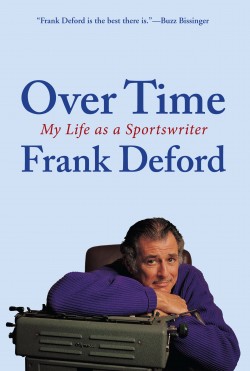
Deford will be on the show to promote his new book, Overtime: My Life as a Sportswriter. Last week, he was thrilled to learn the book hit 30th on the New York Times bestselling list.

“It allows us to put a sticker on the book that says we’re a New York Times bestseller,” Deford said.

The book isn’t selling by itself. Deford said he has given 50 speeches and done more than 100 interviews throughout the country for the book. Trust me, as someone who has experienced the interview blitz on a much smaller scale for a golf book, it can get tedious answering the same question over and over.

Deford, though, isn’t complaining.

“The only thing worse than going out on tour is not going out on tour,” Deford said. “Some people think it’s horrible, but I know there are writers who would kill to get one question.”

This isn’t Deford’s first trip to the bestseller list. But this one is different, he said, because the story is about his life.

“Do I want it to be successful? The answer is yes,” Deford said. “This is a little bit different than the last novel I did. This is mostly about me. Stephen Colbert wouldn’t be having me on to talk about a new novel. (Writing a life-story book) is a one-time thing.  I figured I might as well leap into it, and give it all I have.”


Sunday read: Why Title IX was so important to women in sports media

Title IX didn’t just open doors for women in sports. It also provided opportunities for women to have careers in sports media.

Tom Hoffarth of the Los Angeles Daily New has done a terrific package to celebrate the 40th anniversary of Title IX. Friday, he did a column ranking the top 40 women in sports media. He placed trailblazer Donna de Varona No. 1.

Said de Varona:

My work in Title IX gave me a voice I wanted to have as a broadcaster. But there was a lot of pushback. My visibility was often threatened. I often got comments about my activism being an issue, forcing me to make choices. That did two things for me: It made me fight harder and stay at ABC, and also to work on Capitol Hill.”

Tom also did a series of interviews, asking prominent women in sports media what Title IX meant to them. Here’s the link to Tom’s blog. Just scroll down a bit to get the interviews.

From Lesley Visser:

Billie Jean (King) didn’t just give me a chance, she gave every woman in this country the chance. The Globe made the first woman to cover the NFL as a beat, and when the credentials came (in 1976), it said — get this — “no women or children in the press box.” There were no ladies rooms, because, of course, there were no women!

From Sally Jenkins:

Title IX affected me as a sportswriter because I was maybe one of only a few who began as an intern in 1982 and there were so few out there. Leslie Visser, and maybe a couple of others. But she was having to deal with covering the NFL and having a player like Terry Bradshaw sign an autograph for her when she tried to interview him because he didn’t know better.

It affected me to broaden the range of acceptable professions for females and decide what was the appropriate conduct for women. There were times when I was working at Sports Illustrated, even in the 1990s, well after the passage of Title IX, when I was arguing for a feature story on Jackie Joyner Kersee. The editor said to me: If it’s a choice between her or Michael Jordan, we’ll do a piece on him every time. But why is it a choice? Why can’t we do both? Even as late as the mid ’90s, and sometimes today, women in sports has this underpinning attitude that it comes at the expense of the male’s expense. For Sports Illustrated to do a Jackie Joyner Kersee story was somehow depriving the male athlete of space. That was the attitude. It’s a very unconscious bias but very persistent and needs to be addressed still.

From Mary Carillo:

I was fortunate that the men I worked for kept giving me the chance to do more; virtually all my bosses were men, and still are. It’s not always easy to make your way through an environment that is so male centric, but I’ve had the chances to try a lot of things.  What came my way did not even exist when I started out in sports television.

But I always tell young kids, especially young women who are interested in this sort of work: if you are asked whether you can do something, cover something, bring back a story — say yes. Then go after it with everything you’ve got. And more than anything, support one another.

Madeline Albright says there’s a special place in hell for women who don’t help one another. I believe that with all my heart. All the boats need to rise. Title IX was the first step to an even playing field.

And there’s much more. Take a look.