Sports Illustrated makes staff cuts; hockey writer Farber to be special contributor

As Sports Illustrated gears up for the Olympics, among the most exciting periods for the magazine, it is cutting back.

SI and its related publications will cut 16 staffers in the effort to reduce costs and streamline operations. It had 13 staffers take a voluntary buyout and 3 layoffs. The reductions will take place over a nine-month period.

Among the writers, NFL and golf writer Damon Hack took the buyout and decided to join the Golf Channel. Hockey writer Michael Farber will stay at the magazine as a special contributor.

The cuts come as SI puts out its Olympics extravaganza. The coverage checks in at 66 pages. From the release:

Sports Illustrated previews the 2012 London Games in the July 23, 2012 issue, on newsstands now. This week’s issue features the U.S. women’s gymnastics team on the cover, 66 pages of Olympic preview coverage and SI’s medal picks—gold, silver and bronze—for all 302 events. Sports Illustrated Olympics staff writer Brian Cazeneuve (@BrianCaz)projects that Team USA will retain the overall medal crown, but believes China will finish first in gold medals won (49), four more than the U.S. Considering its strength across dozens of different events, China will likely do the same for many summer Games to come.

Thanks to five young, relatively inexperienced, but technically strong gymnasts, the United States could win its first Olympic all-round gymnastics title in 16 years. The last time women’s gymnastics appeared on SI’s cover was when Mary Lou Retton was on the Aug. 13, 1984, cover.

Leading the pack is 17-year old Jordyn Weiber, the current world champion, and two-time U.S national champion. Weiber was born a gymnast. Her talent is obvious to anyone who watches her perform, but it’s her work ethic and drive that make her a favorite to win the all-around gold. John Geddert, who has coached Weiber for 14 years said, “I’ve seen other kids with her talent, but Jordyn’s hunger to work separates her.”

 Joining Weiber in London is Gabby Douglas, a 16-year old who won the 2012 Olympic trials over Wieber by a 10th of a point. McKayala Maroney, the world champion on vault, floor specialist Aly Raisman and Kyla Ross join Weiber and Douglas on the team (page 70).


Why did Sports Illustrated pass on Posnanski book excerpts?

Here’s the latest as my site has become “Sherman on Paterno book” today:

According to Deadspin, Sports Illustrated passed on an opportunity to run excerpts from Posnanski’s Paterno book.  Deadspin said GQ will publish an excerpt from the book.

John Koblin writes:

But sources at (SI) who read Paterno in galleys say the biography is short on fresh details about the Jerry Sandusky scandal. And Posnanski apparently didn’t wring much out of Paterno that wasn’t already on the record, our sources say.

A source at SI told me after reading the manuscript, “it wasn’t very hard to turn down.”

Wow. Given Posnanski’s skill as a writer and reporter, I find it hard to believe that there isn’t enough compelling material to at least do an excerpt. Posnanski had access post-scandal through the final days of Paterno’s life. Did he really pull a complete whiff there?

Also, isn’t there some value from SI’s perspective to run an excerpt for what is the most anticipated sports book in years? Run the piece and let people judge for themselves. And keep in mind, Posnanski was a feature writer at SI before leaving earlier this year. He’s got friends in the building.

It doesn’t make sense to me. Was there more involved, such as money?

Then again, what if the book really isn’t that good? As I wrote earlier, Posnanski can’t be sleeping well these days.


SI where are they now?: Terrific story on Earl Campbell; Reggie Jackson slams steroids users

Last week, when I heard the annual Sports Illustrated “Where are they now?” issue was coming out, I asked somebody from SI, “Who’s on the cover?”

“I can’t tell you,” the person said.

Really? I knew the choice of the cover for the swimsuit edition was a big secret. But the Where are they now edition?

“Yep,” the person said.

The reality is I am far more interested in the cover choice for Where are they now? than the swimsuit edition. That probably means I’ve gotten really old.

The magazine came today, and voila, there’s Earl Campbell on the cover. Inside, Lee Jenkins did a terrific story on Campbell working to overcome an addiction to pills.

All in all, it’s one of my favorite issues of the year. This one doesn’t disappoint with features on Reggie Jackson, Greg Louganis, among others, and a long essay from the great Roy Blount Jr.

Here’s more on the edition from the SI:

STILL SWINGIN AWAY – PHIL TAYLOR (@SI_PhilTaylor)

Reggie Jackson famously called himself “the straw that stirs the drink,” when he was in his prime hitting home runs for the Yankees and generating headlines for the tabloids in the ‘70s and early ‘80s. When it came to fame, Reggie threw the straw aside and drank it up in huge gulps. Never have a star and a stage seemed more meant for each other than Jackson and New York.  But Mr. October does not starve for the spotlight anymore, largely because he decided to reconnect with his spiritual side in his late 50s. 

Jackson has found peace in his life after his playing career. “I say I didn’t need the attention, but in a way I struggled with the attention. I got mean, mean to the people around me, mean to some of the fans who would approach me. I wanted to create some space for myself, so I developed a shell to keep some peace. After being in the fishbowl of New York, that shell got thicker and thicker. I finally got to the place where I didn’t want to carry that shell around with me anymore.”

Few athletes have ever been as comfortable confronting sensitive topics as Jackson.  It’s when he is plunging into touchy issues that some of the Reggie of old emerges; the only difference is that the star no longer has as big a stage.

Jackson’s stance on the issue of undeserving members of the Hall of Fame: “I didn’t see Kirby Puckett as a Hall of Famer. I didn’t see Gary Carter as a Hall of Famer. I didn’t see Don Sutton as a Hall of Famer. I didn’t see Phil Niekro as a Hall of Famer. As much as I like Jim Rice, I’m not so sure he’s a Hall of Famer.”

On whether Bert Blyleven should have been elected into the Hall of Fame: “No. No, no, no, no. Blyleven wasn’t even the dominant pitcher of his era, it was Jack Morris.”

On being passed on the alltime home run list by players linked to performance-enhancing drugs: “I don’t think the fans really count them, and I agree. I believe that Hank Aaron is the home run king, not Barry Bonds, as great a player as Bonds was.”

On Alex Rodriguez: “Al’s a very good friend. But I think there are real questions about his numbers. As much as I like him, what he admitted about his usage does cloud some of his records.”

Jackson’s view on whether players linked to performance-enhancing drugs should be inducted into the Hall of Fame: “If any of those guys get in, no Hall of Famer will attend.”

On Andy Pettitte’s possible election to the Hall of Fame: “The question is going to be a guy like Andy

Pettitte, who admitted that he got involved for a while, but who is so universally respected in the game. I think he’ll get in, but there will be a lot of [members] who won’t go.” 

Would Jackson attend? “He’s an awfully good friend. I’ve known Andy since he was 20. I’ll leave it there.”

Hal Steinbrenner’s view on the slugger’s relationship with his father, George Steinbrenner: “Reggie is larger than life. That’s why he and my father got along so well. Those last several years my dad began to mellow, and I think Reggie did too. Their relationship became a little less about the emotion of any given moment and more about the long-term friendship.”


LIFE’S ROSES (AND SAUSAGES) – LEE JENKINS @SI_LeeJenkins

Earl Campbell was one of the most talented and most punishing running backs that college football and the NFL have ever seen. His style was to punish defensive players with the ball in his hands. When former defenders describe what it felt like to tackle him, they sound as if they are recalling a near-death experience. Former Oilers safety Bo Eason: “He hit me so hard that both my contacts flew out. The next day we were watching film with our defensive coordinator, Jerry Glanville, and he asked me why I was running the wrong direction the rest of the game. I told him, ‘Coach, I couldn’t see s—. Earl Campbell knocked my contacts out of my head.”

Campbell played only eight years in the NFL and it had an impact on his body that came to haunt him in his 40s.  Arthritis froze his knees, back and feet. He developed gout and diabetes. At 45 he was required to be in a wheelchair. Panic attacks, which had hounded him since retirement, grew more frequent. It was around this time that he began taking OxyContin, up to 10 pills a day, downing each with a Budweiser. It became so bad that during the 30th-anniversary celebration of his winning the Heisman, Campbell struggled to remember names and dates. Said Heisman winner and former NFL running back Eddie George after that celebration: “I stay focused and prayerful that I won’t have to with the situation of Earl Campbell one day.”

In November 2009, Campbell’s two sons, Tyler, who was diagnosed with multiple sclerosis (MS) during his junior season of football at San Diego State, and Christian approached their father and told him he needed help. They drove him to a rehabilitation clinic in Austin. The program lasted 28 days, Campbell stayed 44.

Today Campbell is feeling better than he has in nearly two decades. He’s a special assistant to Texas athletic director DeLoss Dodds, spending a lot of time on campus rehabilitating his knee. His business, Earl Campbell Meat Products is doing very well. It specializes in sausages, as well as microwavable plates of pork, chicken and brisket. His son Tyler, who works with Earl, hasn’t suffered an MS episode in 18 months. Together they are ambassadors for the National MS society, organizing a variety of events to raise money for research. Campbell said, “Some people have a chemical imbalance, I had a chemical imbalance too, until I decided not to put chemicals in there.”


WORSHIPPING AT THE CHURCH OF BASEBALL

The motion picture Bull Durham gave viewers details into the color and craziness of the lives of minor league ball players itching to make it to The Show.  It has since gone on to become a classic, even earning the Greatest Sports Movie Ever in 2003, from Sports Illustrated. Twenty-four years later SI reassembled everyone’s favorite Carolina League roster for a look back at the making of Bull Durham.

Kevin Costner on pitching the film to studios:   “We took Bull Durham around to everybody. Ron [director Ron Shelton] said that he felt like we were a couple of hookers trying to sell ourselves on the street. I had a relationship with Orion, but they had another baseball movie, Eight Men Out.”

Tim Robbins on his character, Nuke Laloosh:  “Nuke was a great character. I always loved the eccentric players—Bill Lee, Jimmy Piersall. . . . When the knuckleball pitcher with the crazy long hair and the attitude comes along, or Bobby Valentine dresses up as Groucho Marx in a fake mustache, those guys are delightful to watch.”

Susan Sarandon on being cast in the role of Annie:  “As a rule, most studio executives’ strong suit isn’t imagination. So when you’re trying to get a part, it helps for them to be able to envision you in the part. I definitely didn’t go in there in a T-shirt and jeans. I remember I had on an off-the-shoulder red-and-white-striped dress. It was very form-fitting. It was understood what I had to do.”

Tim Robbins and Susan Sarandon on their budding relationship:  “Actually, it happened after the movie. I mean, there was an attraction during the movie, and I could see something was changing from friendship to something else, but we both decided we would wait until we cleared up things in our lives,” said Sarandon. “And we have two great children as a result of that movie,” said Robbins.

Director Ron Shelton on dancing coach Paula Abdul:  “I’d never heard of her. But she came up to me and asked, ‘What part do you have for me?’ And I said, ‘What do you mean?’ She said, ‘The producer said that if I did the choreography for Tim you would have a speaking part for me.’ I said, ‘I’m sorry,’ and she marched off screaming.”

Tim Robbins on what has happened to the characters since then:  “Well, I’d like to think that Crash and Annie ended up having a pretty good marriage and that they’re still together. And Nuke? I always thought that Nuke maybe had a flash in the majors and then blew out his arm and is now signing autographs at trade shows. But maybe you shouldn’t print that. That’s the kind of idea that leads to sequels.”


FLYING WITH EASE – REBECCA SHORE

For more than a decade Greg Louganis was the closest thing to perfection the diving world has witnessed, winning five world and 47 national titles, and, most memorably, four Olympic gold medals and one silver across three Games (’76, ’84 and ’88), often by eye-popping­ margins. Later, his book, Breaking the Surface, would change his life forever.  Louganis revealed a history of abuse—emotional­ from his father, physical and sexual from a partner—and his own battles with depression and addiction to alcohol and painkillers. He also declared that he was gay and HIV positive. Following the release, Louganis received a lot of backlash and was hurt by the lack of contact from USA Diving. His coach and mentor, Ron O’Brien, told him it would take time for USA Diving to come around.

It wasn’t until 2011, when USA Diving invited him to become an athlete mentor, that Louganis started working with the organization again in an official capacity. And since early last year he has served as a vice president of the U.S. Olympians Association, a support network for former U.S. Olympic athletes. He has been especially busy in the months leading up to the London Games. In his capacity as a coach, Louganis has worked on breathing exercises with divers such as David Boudia and Nick ­McCrory. Today Louganis talks freely about the darker times. He says, “I could make that my story and say, woe is me, but that’s not who I am. I wrote [Breaking the Surface] to let go of it. It’s history.”

DEEPNESS IN SEATTLE – L. JON WERTHEIM (@Jon_Wertheim)

From draft pick who never played Division-I basketball, to superstar, to punchline, Shawn Kemp’s story arc is unlike any other in NBA history. But these days, 15 years after he was traded by the Sonics in a sour divorce, the man they once called the Reign Man has moved back to Seattle and embraced the city that first embraced him. Heb has put his personal and legal troubles behind him, owns a restaurant and even plays in a flag football league. He’s more of a local fixture than a celebrity, and he is as revered as ever to locals. Seattle is Kemp’s home, and, he says: “It’s like you can get lost here, but you can’t get lost,” he says. “It’s big enough that people respect your privacy but small enough that you get to know a lot of people. Really, it’s been fabulous.” (page 74).


THE STRENGTH TO CARRY ON – DAVID EPSTEIN (@SIDavidEpstein)  

Ben Helfgott may have been an Olympic weightlifter for Great Britain in 1956 and 1960, but that is not where his story begins or ends. In September of 1939, when he was 10, Helfgott’s Polish town of Piotrkow was blasted to rubble by German bombers. Throughout the next six years the Helfgotts hid out in ghettos but eventually became prisoners in concentration camps. In May of 1945, Helfgott walked out of Theresienstadt concentration camp as an 80-pound sack of bones. Almost his entire family had been killed in the camps.  He still talks about the war, saying: “If I forget, then I’m not worthy of being a survivor.” As a 15-year-old he was sent to live in a group home in England with the other 731 orphans from WWII to become part of a group known as The Boys. As The Boys grew into men, Helfgott discovered weightlifting and began training after work as a regional housewares sales manager. When his weightlifting career was over, he became captain of The Boys and chairman of their charity in 1963. Today he coordinates a large gathering of The Boys and their families each year, even though fewer than 250 of the original members are alive. “You’ve always got to live with hope that things will be better. One thing I’m certain of, people are capable of a lot,” Helfgott said.


WHY DON’T MORE ATHLETES TAKE A STAND? – GARY SMITH

There was a time when American athletes placed a major emphasis on making the public aware of their stance on important issues.  Jim Brown, Bill Walton, Arthur Ashe and Tommie Smith all took a stand on some of the world’s most sensitive issues but few athletes do that. In many instances this has to do with fear of upsetting fans or corporate sponsors. John Carlos, who, in an effort to bring attention to racism in the U.S., raised his black-gloved fist on the medal stand after winning a bronze in the 200 meters at the 1968 Summer Games and “brought all hell down upon his head,” said, “Athletes today? They don’t know history! They don’t want to come out of their box and risk people taking away their lollipops.”

This is what makes what Joseph Williams did at the University of Virginia so special. Williams, a walk-on on the Cavaliers football team, went on a hunger strike this past semester to bring awareness to a Living Wage campaign, which is fighting for the workers on the campus in Charlottesville, so that they may earn a decent salary. Many of the workers on campus grew especially close to Williams throughout his first few years in school, while still rehabbing his injured ankle, taking a full course load of classes and participating in volunteer work that is so special to him. Some teammates thought he was crazy, and his coaches didn’t approve of his decision to go on a hunger strike, but he recognized the importance of taking a stand, as well as the impact an athlete can have.

If a walk-on athlete can make this much of difference, it makes you wonder what a star could accomplish. Dr. Harry Edwards says of athletes, “They have to speak up. They’re the most visible expression of achievement and financial success in the country. Actors in Hollywood have always been very outspoken. Athletes have surpassed them as Number 1 entertainers; they should be at least outspoken. Those who set the table that today’s athletes are dining at, they exercised that responsibility. Now you have to get past an athlete’s corporate and personal advisers, and so he’s got to think what’s in the best interest of Buick and Nike and Starbucks and General Electric.”


RAY LEBLANC – MATT GAGNE

The 1992 U.S Olympic hockey team made the medal round for the first time in 12 years, and Ray LeBlanc was a major part of its success. He was a minor leaguer turned Olympic goalie, averaging 2.20 goals against with a 94.6 save percentage during the Games. “He seemed destined to land a full-time NHL job,” wrote Matt Gagne.

But LeBlanc never got the successful NHL career many predicted. He played one 60-minute game for the Chicago Blackhawks, before returning back to the minor and international leagues. Although he was eligible for that summer’s expansion, he was not selected. LeBlanc now calls Largo, Fla., home. Instead of skating, he spends his days fishing, spending time with his family, volunteering with the homeless or working in receiving at Budweiser at Great Bay Distributors. “I really like driving a forklift,” he said.


ERIC MCCOO – MATT GAGNE

A decade after he left Penn State ranked ninth on the school’s alltime rushing list, Eric (Choo Choo) McCoo is still playing on Sundays. The 31-year-old was picked up two years ago by the Legion of Doom, a team that plays Sunday mornings in the lowest level of a three-tier flag football team in Bolingbrook, Ill. “My body doesn’t function like it used to, but I always find myself in the right position because of my background,” McCoo says. “Not many people know I played in the NFL.”


JOHNNY NEWMAN – STEPHANIE APSTEIN

Until recently, the man with the most losses in the history of professional basketball (664) didn’t even know that he holds that record. A second-round pick in 1986 out of Richmond, Newman played 16 years at guard and forward in the NBA. He laced up alongside such likely Hall of Famers as Patrick Ewing, Tim Hardaway, Ray Allen, Steve Nash and Dirk Nowitzki – but almost all near the start of their careers. “I had the opportunity to be around guys who became great players. Unfortunately my record took a hit because it was early and they all were still learning to play the game.”


Newman, 48, retired in 2002 and moved back to Richmond. He now dedicates his time to many ventures including the Johnny Newman Foundation, which he started in 1985 to mentor underprivileged kids.


CHRIS DUDLEY – STEPHANIE APSTEIN

When he was diagnosed at age 16 with type 1 diabetes, Chris Dudley refused to let his condition stop him from playing basketball. Told by doctors that he would never be able to play in college or professionally, Dudley walked onto the Yale basketball team and was drafted 75th overall by Cleveland in 1987. He played for five teams in 16 seasons and retired in 2002. In 2005 he became a partner in Filigree Advisors, a Portland-based wealth-management company that specializes in helping current and former professional athletes manage their finances. In 2010, Dudley ran for governor of Oregon and lost in one of the closest gubernatorial races in state history. Today he manages the Chris Dudley Foundation, which aids diabetic children and runs a basketball camp annually for 75 diabetic teens. “It’s incredibly difficult for someone with diabetes but don’t let it stop you,” Dudley said.


ANTHONY YOUNG – DAN GREENE (@thedangreene)

Anthony Young holds a dubious record. From 1992-93 he lost 27 consecutive decisions, a number that has not come close to being topped in the last 19 years. But that streak and his career record (14-48) haven’t stopped Young from staying close to the game. The former pitcher, who lives in Houston coaches one of the top-ranked Little League in the country. Young says he took lessons from enduring his historic streak as well as the encouragement he received at the time from Hall of Famers, teammates and opponents. Now, he just wants to pass those lessons on to young kids. Of breaking the infamous record, Young says: “It was like the zoo had been lifted off my back and we had just won the World Series.” (page 110)


Sports Illustrated writers to take TV spin with new NBC show

NBC Sports is tapping into Sports Illustrated for its version of Real Sports and E:60.

The interesting part is that the show won’t have a host (think 60 Minutes) and the reports will be filed by SI’s writers. Some of them already have TV experience, such Tom Verducci, Peter King, Seth Davis, and Grant Wahl.

For others, though, working the TV side in this kind of format will be a new experience. Can’t wait for the first Richard Deitsch installment.

Here’s the release:

The NBC Sports Group and the Time Inc. Sports Group will partner to produce “Sports Illustrated,” presented by Lexus, a monthly, hour-long sports magazine TV show. The announcement was made today by Jon Miller, President of Programming, NBC Sports and NBC Sports Network and Time Inc. Sports Group President Mark Ford. It was also announced that Lexus will be the program’s presenting sponsor.

“Sports Illustrated” presented by Lexus debuts Tuesday, July 24, 9:00 p.m. on NBC Sports Network. The show will deliver the magazine’s DNA of award-winning storytelling through feature segments, original reporting and commentary from SI’s trusted journalists. It will also tap into the SI Vault to spotlight great stories from the past, updating our favorite characters and events. Emmy Award-winning Red Line Films has been tapped to produce the show

“Sports Illustrated is an iconic brand and the gold standard in long-form journalism,” said Miller. This programming fits incredibly well with our rich history of storytelling, and partnering with Sports Illustrated for this show adds even more quality programming to NBC Sports Group’s growing portfolio.”

The premiere episode will air just three days prior to the Opening Ceremony from the 2012 London Games with subsequent new episodes originating on either NBC Sports Network or NBC. At least one featured subject from the show will be chronicled in the magazine’s current issue and additional editorial vehicles across SI.com and NBCSports.com will surround and amplify each new episode.

“This is an exciting opportunity to further expand Sports Illustrated storytelling beyond the magazine and our digital offerings,” says Ford. “We have a terrific partner in the NBC Sports Group and are incredibly optimistic about the show’s potential for our franchise and for sports fans.”

“Sports Illustrated’s writing and photography have been intrinsically tied to television sports coverage for nearly 60 years,” said Terry McDonell, Time Inc. Sports Group Editor. “Working with the NBC Sports Group and Red Line Films takes us to a new level.”

The following is the show’s schedule (All times ET):

Episode #1 July 24 9:00 p.m. NBC Sports Network

Episode #2 September 12 9:00 p.m. NBC Sports Network

Episode #3 October 13 2:30 p.m. NBC Sports

Episode #4 November 3 2:30 p.m. NBC Sports

Episode #5 December 13 9:00 p.m. NBC Sports Network


Make up your mind SI: Is it LeBron’s era or Durant’s?

There’s a fundamental problem when you anoint a new era in a sport before the finals is played. Your new era guy might lose out to the old era guy.

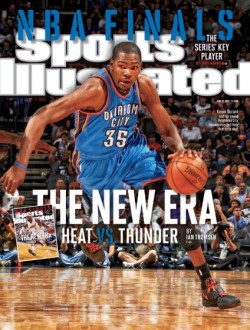
A few weeks ago, Sports Illustrated ran Kevin Durant on the cover with the big headline declaring: “The New Era.”

Then mockingly, it had a small insert of an old SI cover declaring LeBron James as “The New Era.” Hey, LeBron, you are so yesterday.

Well, now we all know the rest of the story. James and the Heat defeated Oklahoma City in five games.

As a result, SI went back to the old era with James on the cover this week. Lee Jenkins wrote a post finals piece with the now official King of basketball.

Who knows? Perhaps the Durant cover inspired James?

And who knows? Perhaps Durant was done in by yet another tale of the SI cover jinx?


The beat: Beleaguered Schilling earned $114 million for pitching; Will any writers take SI buyout offer?; Simpson’s winning line

Curt Schilling’s problems have gotten so bad ESPN granted him a leave of absence.

I’m not completely familiar with all the legal issues surrounding his video game company, 38 Studios, which has filed for bankruptcy. However, I did find this interesting stat about Schilling:

According to Baseballreference.com, Schilling earned $114 million during his baseball career. And there had to be several million more in endorsements.

All of which begs the question: How much money does a person need?

Changes: It has been disclosed that Sports Illustrated is making some changes to better integrate its magazine and on-line operations. It will result in a handful (less than 10) of staff reductions. Buyouts are being offered, and it will be interesting to see whether any of the writers will grab one.

Bloomberg reports:

Terry McDonell, editor of Time Inc.’s Sports Group, said in a telephone interview yesterday that he is looking to reduce positions of editors and reporters with buyouts being offered through June 21.

“Everything is about money eventually and being more efficient,” he said. Although Sports Illustrated, which has 210 editorial employees, is “very profitable,” the reductions will allow the magazine to become even more so, he said.

Idiot patrol: I hate calling attention to idiots. However, I did like Webb Simpson’s line after some goofball interrupted his award ceremony Sunday.

“Enjoy the jail cell, pal,” Simpson said. Well played.


SI says LeBron James is so yesterday; ‘New Era’ Durant on cover

Interesting cover for Sports Illustrated this week.

It features Kevin Durant with the headline: “New Era.” Over to the left, is a small photo of an SI cover of LeBron James with the same “New Era” headline.

Youhave to say SI is right based on Tuesday’s game. However, if James and the Heat win the series, what will be SI’s cover headline? Return of the old era?

From the release:

A new era in the NBA has arrived and it has taken two men to deliver it. LeBron James, 27, and Kevin Durant, 23, are the key players of this post-Kobe era, and each is seeking his first title at the other’s expense. The last Finals to launch a new generation with so much anticipation and promise was the showdown between the Lakers and the Celtics in 1984, when Magic Johnson’s Lakers lost to Larry Bird’s Celtics over seven memorable games. A look inside the much anticipated match-up of the two best players in the league during this year’s NBA Finals is the cover story for the June 18, 2012, issue of Sports Illustrated, on newsstands now.

Unlike Johnson (a point guard) and Bird (a small forward), who rarely guarded each other, James and Durant will match up for a majority of their minutes, making for must-watch TV. The two players forged a friendship this past off-season. Durant spent four days in Akron working out with James, where they consoled each other about their shared troubles with the veteran Mavs, who had KO’d the Thunder last spring before upsetting the Heat in the Finals.

LeBron James said, “We pushed each other each and every day. I envisioned us getting to this point.”

Also, here’s a preview of story by Chris Mannix on Durant and Russell Westbrook:

Oklahoma City point guard Russell Westbrook may not be the biggest name in the Finals, but how well he runs the Thunder’s offense will determine which team goes home with a championship. Consider Westbrook’s job description: Don’t just score, create, and do it while keeping the turnovers down, the shooting percentage up and, oh, yeah, making sure the NBA’s scoring champ, Kevin Durant, is getting enough shots. Not since Allen Iverson has an elite point guard been asked to play such a multifaceted role.

Westbrook’s relationship with Durant has been dissected at a Kardashian level. Critics have wondered whether two alpha males can coexist, bringing up examples of discord (a well-publicized blowup on the bench in Memphis last December) and statistics (Westbrook’s hoisting up nearly as many shots as Durant in a bumpy 2011 playoffs) as proof that they can’t. What’s rarely cited is how Westbrook and Durant were inseparable during All-Star weekend or how the two routinely text each other about anything, from basketball to video games, late at night. Nor is it often noted that the duo scored more points per game (51.6) than any other tandem this season, or that when the game is tight, Westbrook defers: With a minute to play and the score within three points, Durant has attempted 37 shots, Westbrook eight.

Says Westbrook:“People keep trying to break me and Kevin up. But we just keep getting closer.”


This week’s SI: Josh Hamilton Talks About Relapses, Religion, Family and Baseball

I figured it was just a matter of time before Josh Hamilton landed on the cover of Sports Illustrated.

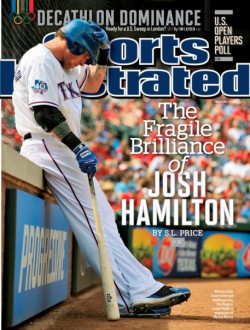
So it’s hardly a surprise that he is on the cover of this week’s edition. The shot, though, is a bit unexpected. Instead of depicting Hamilton in full power at the plate, it shows him in a reflective pose with his head down.

The photo ties in with the headline: “The fragile brilliance of Josh Hamilton.”

From the release:

Texas Rangers centerfielder Josh Hamilton is on pace to have one of the greatest seasons in major league history, but one night earlier this year could have altered everything. Hamilton’s battle with drug and alcohol addiction had wasted five years of his career and an alcohol relapse in a Dallas bar in late January gained national attention. His family, teammates, the Rangers organization and most important Hamilton have moved on from this worrisome moment, but the difficult journey Hamilton faces every day is the cover story for the June 11, 2012, issue of Sports Illustrated, on newsstands now. This is the second time Hamilton as appeared on the cover, the first was on June 2, 2008.

 Rangers manager Ron Washington knows the cost of bad choices, as he tested positive for cocaine during the 2009 season. He and Hamilton talk frequently about temptation, the game, people and what it means to be a man. Washington says, “Sometimes he can’t sleep at night. This is when the demons start to come out of him, and he needs someone to talk to. Sometimes it takes 20 minutes up in here, and sometimes we take a half an hour. Then he leaves, and I’m cleansed and he’s cleansed.”

 Senior writer S.L. Price spoke with Hamilton’s wife, Katie, about the battles and the two relapses Josh has had over the last four years. Katie, who like Josh is a born-again Christian, credits their faith for saving Josh’s life, their marriage, his body and talent for the moment when he could return to baseball. After all she has been through with Josh, it would be easy to write off what happened in January, but Katie says, “People that don’t know me probably think I have some kind of co-dependence issue, like I get my value in helping him.  Absolutely not. I fully expect him to be the man and husband that God has called him to be. I should never have to assist him in this.”

 As Hamilton continues to put up what could be historic numbers, through Sunday, he was hitting .354 and leading the majors in homers (21), RBIs (57), OPS (1.138), total bases (142) and slugging percentage (.728), for him, it will be his faith and hard work that keeps him going every day.

Also, On the Tablet: Podcast with S.L. Price and Richard Deitsch and a video of Hamilton’s four-HR from earlier this season.

Pearlman tells complete story of infamous John Rocker story

There’s the story that gets printed in a publication. Then there’s the story behind the story.

Often, the latter is just as interesting.

Jeff Pearlman has decided to tell what happened before, during and after his infamous story on John Rocker that ran in Sports Illustrated in 1999. He writes about the weird encounters on his JeffPearlman.com in response to Rocker knocking him in a recent interview.

Rocker said of Pearlman:

Pearlman spent nearly 10 hours with me that day and we engaged in numerous very long-winded conversations on everything from how to throw a breaking ball to the effects of a flawed U.S. immigration policy. Strategically extracting a sentence fragment here and separate thought there Pearlman painted the exact picture of me he intended from the very beginning and in doing so remained true to form and consistent with his long and decorated history of trash journalism. In my research I have found that Pearlman has done eerily similar hatchet jobs to dozens of other subjects during his 20 year career.

Pearlman decided he couldn’t let the comments go. He goes into the details of how Rocker went off his rocker.

Pearlman writes:

Rocker has said and said and said that his words were taken out of context; that, in and of themselves, they sound awful. But that we were actually discussing, oh, foreign policy and race relations and the such. This, of course, is a complete lie. Like, not even close to the close to the close to the truth. He said what he said because he was—and still seems to be—quite stupid. Stupid people call black teammates “fat monkeys,” and berate “queers with AIDS” on the New York City subway. At the time, Rocker was dating Don Sutton’s daughter. He was also dating another young woman. One of his girlfriends (I can’t recall which) was in the car with us. When she left, he called the other.

My favorite moment actually never made print. We were driving around Atlanta—girlfriend in the front seat, me in the back—when Rocker asked whether I’d ever been to Disney World.

“I have,” I replied.

“You know all those characters who walk around the park—Mickey, Donald, Minnie …”

“Sure,” I said.

“Well, they’re all faggots,” he said. “They’re all fucking faggots.”

Pearlman also writes about Rocker threatening him in a clubhouse encounter after the interview:

Rocker spent the ensuing two minutes (felt like 10) in my face, jabbing his finger into my chest, blasting me for ruining his career, his family. He said, “Do you know what I can do to you?”—and I thought, “Yes, beat the living shit out of me.” My only strong moment came midway through, when he said, “I even bought you lunch!”

“Actually,” I said, “I paid.”

“Well, fuck you …”

Read the entire piece and tell me who you’re going to believe.


This week’s SI: The untold story about steroids in baseball

Back in 2002, Ken Caminiti’s revelations in Sports Illustrated blew open what was painfully obvious: rampant use of steroids in baseball.

This week, Caminiti, who died of a drug overdose, is back on the cover of SI. However, on the 10th anniversary of the original story, SI’s Tom Verducci takes a different approach on discussing the impact steroids had on the game.

His opening paragraph:

This is a story about the real cost of steroids in baseball–not the broken records, not the litigation, not the talk-show drone about the elite players who juiced and how to weigh their Hall of Fame candidacy. This is a story about the hundred, even thousands, of anonymous ballplayers whose careers and lives were changed by a temptation that defined an era.

Kudos to Verducci and SI for detailing the deeper implications here. It went far beyond Bonds, McGwire, Clemens, Sosa, etc..

This is a must-read story. One of the best I’ve seen in SI in a long time.

From the release:

(Verducci) examines the playing careers of four right handed pitchers who were members of the Minnesota Twins organization in mid-to-late 1990s. They had similar skills and backgrounds. None were drafted by the Twins higher than the fourth round of the MLB amateur draft. One of the four, however, took steroids, and he was the only one who ever reached the major leagues. His name was Dan Naulty and his decision to cheat the game, his teammates and himself affected all their lives.

Naulty was 6’6’’ and 180 pounds as a senior at Cal State Fullerton, had a fastball that sat around 85mph and was drafted in the 14th round. After using steroids and other performance-enhancement drugs, he began throwing his fastball at up to 95mph and at one point weighed 248 pounds. He spent three seasons with the Twins, pitching in 97 games before being traded to the New York Yankees in 1999, where he won a World Series.

On the outside, he looked like many other major leaguers, but inside he was an emotional wreck from the steroids, the guilt of cheating and a drinking problem. Naulty hit rock bottom just after the World Series. After a night of celebrating with some teammates, Naulty asked his driver as they crossed the George Washington Bridge, “Tell me. Tell me if this is all there is to life. Because if this is all there is, just stop this car right now and I’ll jump…. I had no hope. I had sold myself that bill of goods so long that I believed it. But I realized at that moment I had totally destroyed my life. And I had destroyed countless other people’s lives. I was ready to die.”